
How to Search King County Traffic Court Records
District Court's ticket page is the starting point for most county traffic matters. You can find a case using a vehicle license, a ticket number, or a name. The page supports online payment, and it links the options for mitigation and contested hearings. A public search page uses a CAPTCHA to block automated submissions, and a full web hearing requires a free portal account.
- Open the District Court ticket page.
- Search by vehicle license, ticket number, or name.
- Complete the CAPTCHA on the public search page.
- Open the matching case to see the citation and options.
- Pay, request mitigation, or request a contested hearing.
The official tool is the District Court ticket page.
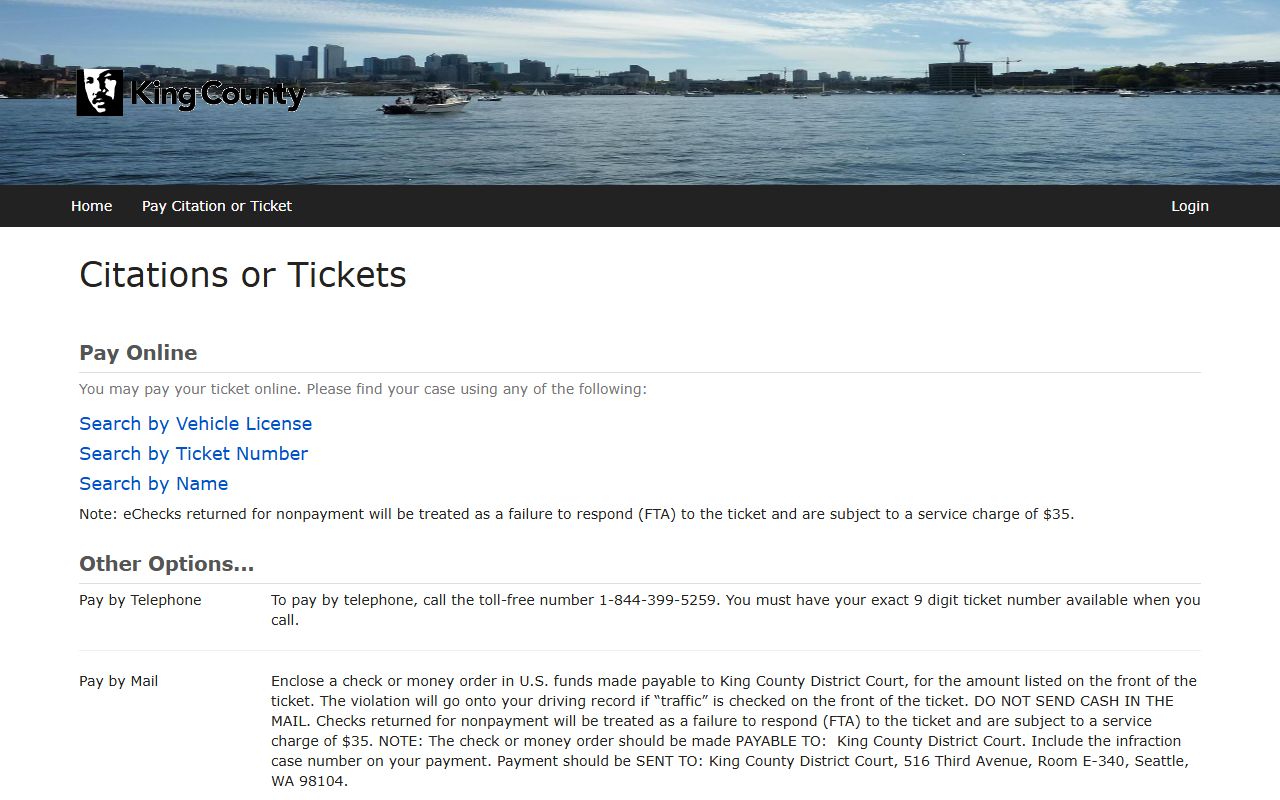
That page lays out payment, mitigation, contested-hearing, and web-statement choices in one place.
Which Courts Handle Traffic Cases in King County
Not every ticket goes to the same court. King County District Court handles many county and contract-city traffic citations, infractions, and parking matters. City municipal courts handle many city-issued tickets, with Seattle Municipal Court taking City of Seattle matters. The court named on the ticket is what decides where a response goes.
This split matters for searching. A ticket from a contract city may appear in District Court, while a Seattle city ticket will not. If a District Court search returns nothing, the case may belong to a municipal court instead.
King County District Court provides municipal court services for several cities by contract, including Auburn, Bellevue, Burien, and others, but not for every city. That is why the same court can hold a city's traffic cases in one place and not another. The single most reliable guide is the courthouse name printed on the ticket, which tells you exactly where to respond and where to search. When in doubt, the District Court general line can confirm whether a citation belongs to the county system or a city court.
Types of Traffic Cases on Record
Traffic records cover a range of matters, from minor infractions to criminal charges. The category affects how the case is handled and whether it touches your driving record.
- Moving infractions, such as speeding or signal violations.
- Parking and non-moving violations.
- Photo-enforcement citations from cameras.
- Criminal traffic, such as DUI or driving while suspended.
Serious criminal traffic matters route as criminal cases rather than simple infractions, which changes both the court process and the record. An infraction is a civil traffic matter resolved by paying, mitigating, or contesting, while a criminal traffic charge can mean an arraignment and a possible jail booking. The line between them decides whether you handle the case on the ticket page or through the criminal court process.
What King County Traffic Court Records Show
A traffic record holds the details of the citation and the case. The fields below appear in a typical King County traffic court record.
| Field | What It Shows |
|---|---|
| Citation / Ticket Number | The number identifying the ticket |
| Vehicle License | Plate and state, used for parking search |
| Respondent Name | The person cited |
| Violation | The statute or ordinance cited |
| Court Location | The courthouse from the ticket |
| Hearing Type | Mitigation, contested, or web hearing |
| Fine / Status | Penalty amount and payment status |
| Disposition | Committed, not committed, dismissed, or deferred |
Failure to respond can lead to added consequences, such as a referral to collections or a license action, depending on the case type.
Searching by Citation Number vs by Name
The District Court ticket search gives you more than one way in. A ticket number is the most precise, a vehicle license works for parking, and a name search casts a wider net. Each path has its own quirks.
| Field Label | Type | Required | Notes / Format |
|---|---|---|---|
| Search by Vehicle License | Form | No | Vehicle state code and plate number |
| Search by Ticket Number | Form | No | 9-digit ticket number for phone payment |
| Search by Name | Form | No | Name search option |
| CAPTCHA | CAPTCHA | Yes | Required on public search pages |
| Web Hearing | Account workflow | Conditional | Requires a free portal account |
For telephone payment you need the exact nine-digit ticket number. A web hearing or statement requires logging in and selecting the case in the portal.
Paying or Contesting a King County Traffic Ticket
You have several ways to respond to a ticket. You can pay it, ask to mitigate it, or contest it. Each choice has a different result, so pick carefully before the response deadline.
- To pay online, find the case on the ticket page and pay the fine.
- To pay by phone, call 1-844-399-5259 with the exact nine-digit ticket number.
- To pay by mail, send a check or money order payable to King County District Court with the case number.
- To mitigate, check the mitigation box on the ticket and mail it to the listed courthouse.
- To contest, check the contested box, and the city or state must prove the violation.
Mitigation admits the violation but lets you explain the circumstances, and the court sets a hearing date. Contesting challenges the violation, and the city or state must prove it by a preponderance of the evidence. You can request witnesses, including the officer, through the court's subpoena process, so contact the court for the subpoena steps if you plan to contest. A web statement option also lets you respond in writing after searching and selecting your case in the portal, which requires a free account.
Note: A returned check or eCheck is treated as a failure to respond and carries a $35 service charge, so confirm funds before paying.
Public Access Laws for Traffic Court Records
Traffic court records are court records, governed by court rules rather than the agency Public Records Act. Access follows GR 31, the same rule that opens other court records, and District Court withholds personal identifiers such as addresses, phone numbers, and dates of birth from its portal under GR 31. Mitigation and contested outcomes can post to a driving record when traffic is checked, except for traffic-camera citations, parking, and deferred findings.
For the broader public-access framework, see the public records page, and for general case access see court records.
Court Traffic Records vs State Driver Records
This is the distinction that confuses the most people. The court traffic record and the state driver record are two separate files. The court record lives with the court that processed the citation. The driver record lives with the Washington Department of Licensing. They serve different purposes and are requested in different ways.
| Court Traffic Record | State Driver Record |
|---|---|
| Held by District or municipal court | Held by the Department of Licensing |
| Shows citation, court, hearing, and disposition | Shows license status, convictions, and suspensions |
| Used to pay, contest, or get court records | Used for licensing, insurance, and employment |
| Searched through the court portal | Requested through the DOL driver-record process |
Clearing a court case does not by itself rewrite your driver record, and a driver-record question goes to the Department of Licensing, not the court.
CDL and Commercial Driver Records
Commercial drivers face stricter rules. A citation that a regular driver might mitigate can carry heavier consequences for a commercial driver license, and certain dispositions that help an ordinary driver are not available to a CDL holder. Because a CDL touches a person's livelihood, it is worth checking how a ticket will be reported before choosing how to respond. The court handles the citation, but the licensing impact runs through the state driver record. A commercial driver who is unsure how a disposition will be reported should ask before resolving the ticket, since some options that erase an infraction for an ordinary driver are limited or unavailable for a CDL. The Department of Licensing, not the court, controls how the conviction reports to a commercial record.
DUI and DWI Cases
DUI is not a simple infraction. Driving under the influence is a criminal matter, and serious criminal traffic cases route through the criminal court process rather than the ticket page. That means a DUI shows up as a criminal case, with arraignment, possible jail booking, and a different record path. For how those records work, see the arrest records page and the court records page.
Deferred Findings and Defensive Driving
Washington allows some options that keep an infraction off a driving record if conditions are met. A deferred finding, where available, holds the case open and can lead to dismissal if the driver stays compliant. A defensive driving course may be an option in some cases. These choices vary by court and by the driver's history, so the court that holds the ticket is the place to confirm what is allowed. Deferred findings are among the dispositions that do not post to the driving record the way a committed infraction does.
Sealing, Name Changes, and Traffic Records
Court records, including traffic cases, can sometimes be restricted by court order under GR 15. Name changes are handled by District Court, and a confidential name change may be available where safety concerns apply. That confidentiality is set by statute.
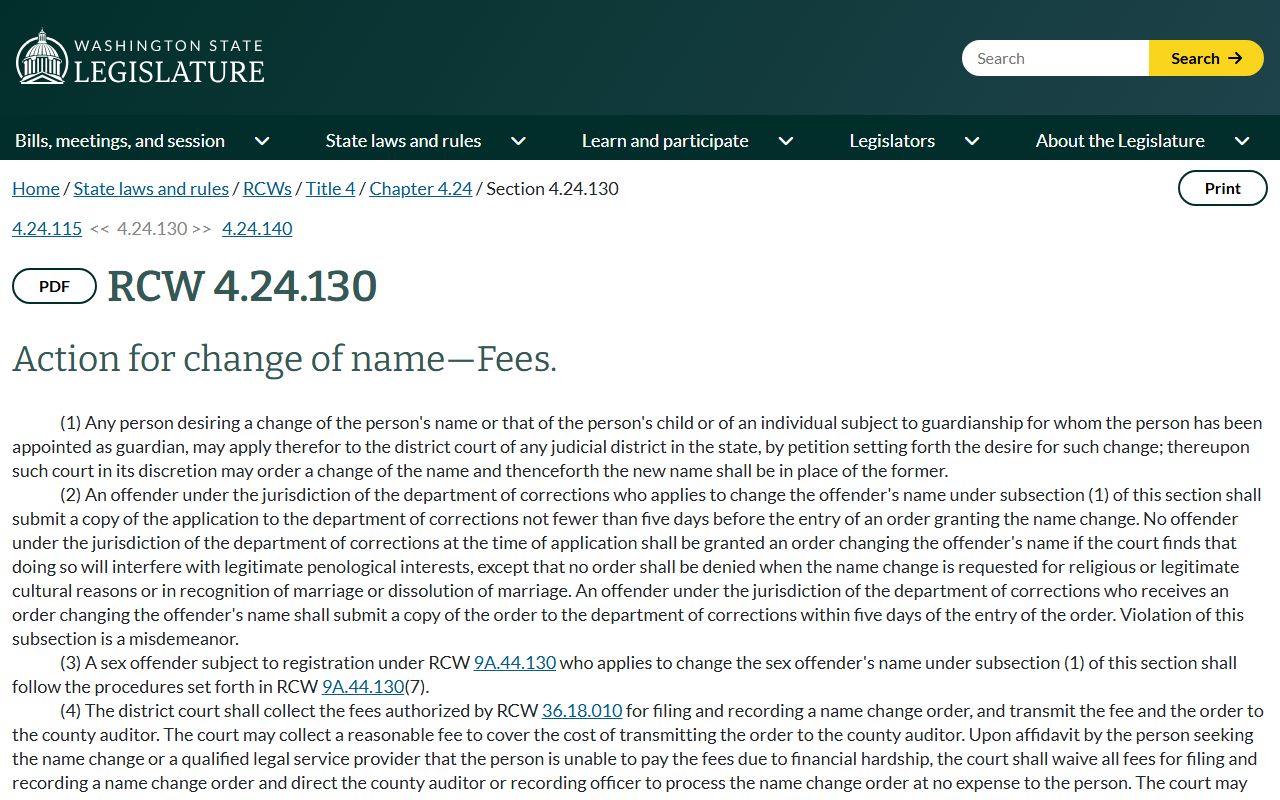
Name-change and confidential name-change provisions sit in RCW 4.24.130. Sealing a traffic-related court record follows the same court-rule process used for other case types.
Fees for Traffic Record Copies and Payments
Traffic payments and copies carry their own charges. Fines depend on the violation, and a few service charges apply across the board. The table shows the payment-related charges from the official ticket process.
| Item | Amount |
|---|---|
| Telephone payment line | 1-844-399-5259 |
| Returned check or eCheck service charge | $35 |
| Mail payment | Check or money order to King County District Court |
For certified copies of a court traffic record, the District Court records process applies, and exact copy charges should be confirmed with the court. Mail payments go to King County District Court, 516 Third Avenue, Room E-340, Seattle, WA 98104, and cash should not be mailed. For the trial-court structure behind these cases, see the Superior Court page, which also covers District Court.