
How to Search King County Court Records
The Superior Court Clerk runs KC Script, the online portal for King County Superior Court records. It lets you view, request, and purchase records, but the Clerk is clear that the online data is not the official court record and may contain errors. A filing or hearing can take up to three court days to appear. District Court keeps its own e-Filing and Case Access portal for misdemeanors, infractions, civil, and small-claims cases. Pick the court that matches your case before you search.
Gather what you have first. A party name works, and a case number works better. Superior Court case numbers from after July 1, 1979 use the format XX-X-XXXXX-X. If you only have a name, expect to add a filing-date range to narrow the list.
- Decide whether the case is Superior Court or District Court.
- Open KC Script for Superior Court, or the District Court Case Access portal for District Court.
- Accept the portal terms and pick the case type.
- Search by case number, or by party name with a filing-date range.
- Open the docket, then request a certified copy from the Clerk if you need an official record.
You can read the portal's public-access terms first through the KC Script public access page, which spells out the official-record disclaimer.
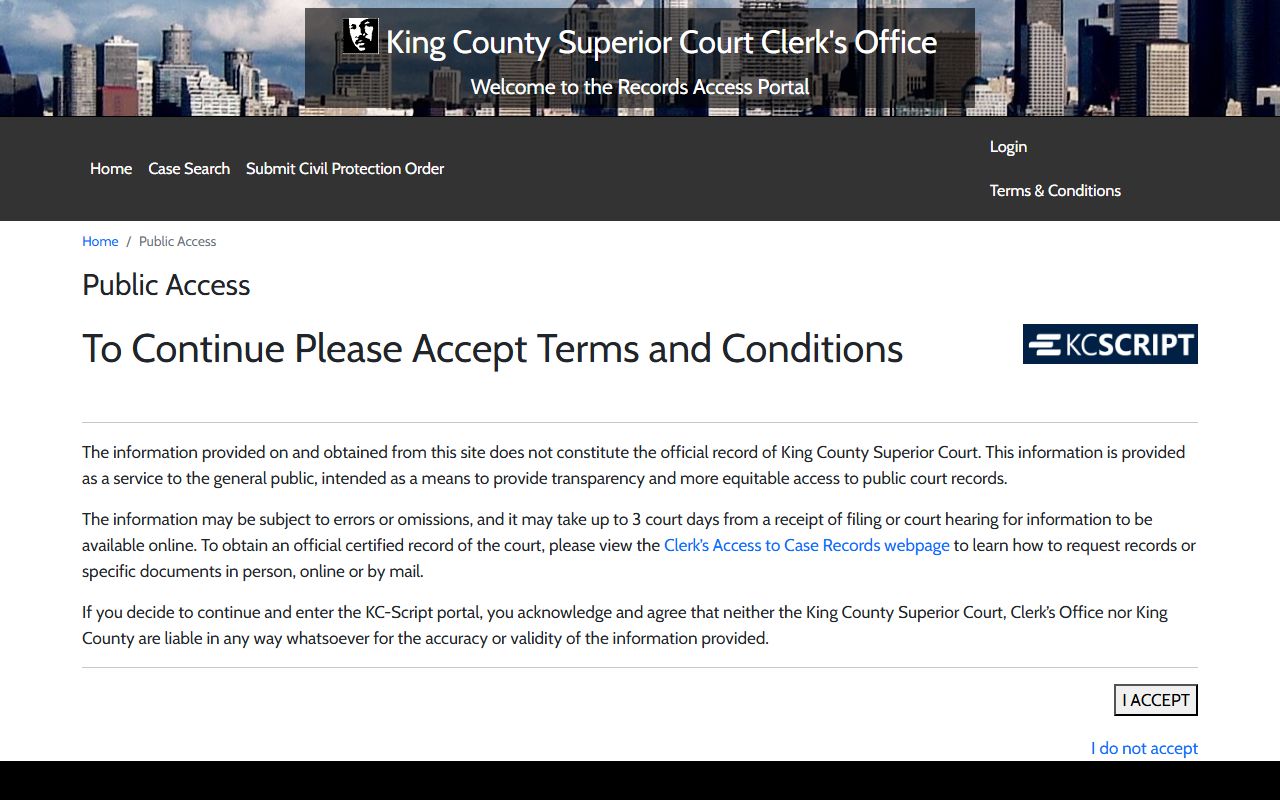
That page also explains that an account is needed to request, view, or download documents through the portal.
King County Superior Court Case Types
The KC Script Case Search menu sorts Superior Court records into categories. The first four are the most used. Each one points at a different kind of file, so picking the right type keeps your results clean.
- Criminal, Case Type 1 - adult felony cases prosecuted in Superior Court.
- Civil, Case Type 2 - lawsuits, evictions, and judgments, with some protection-order types excluded online.
- Family or Domestic, Case Type 3 - divorce, custody, child support, and family law.
- Probate or Guardianship, Case Type 4 - estates, wills, trusts, and guardianships.
- Other categories - parentage, juvenile offender, judgments, land title, search warrants, will repository, and sealed cases.
The full menu lives on the KC Script case-search menu, where you choose the category before entering search terms.
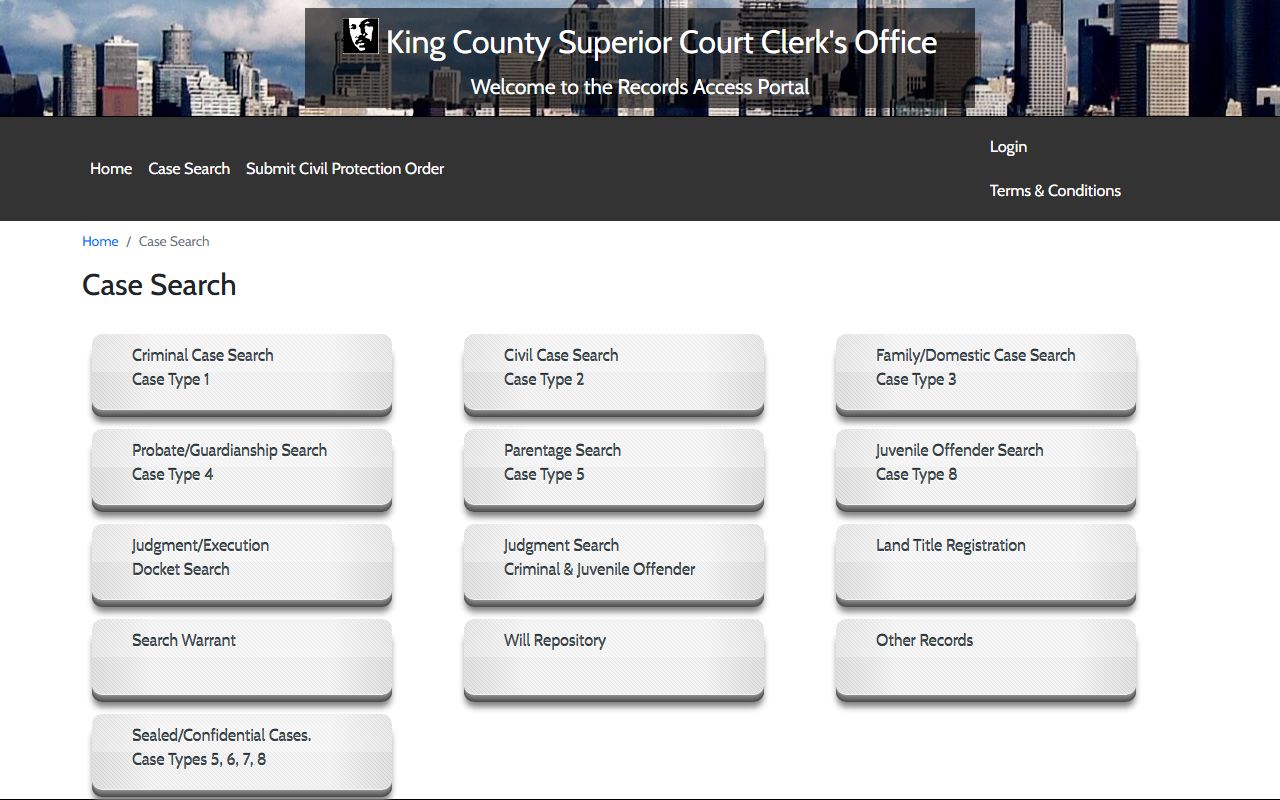
If a case does not fit a standard category, the Other Records option handles it.
King County Court Records Search Fields
For Superior Court Case Types 1 through 4, KC Script offers the same core fields. You can search if you know the case number or the party name. The portal supports text operators such as starts with, contains, and soundex for names, plus preset date ranges for filing dates.
| Field Label | Type | Required | Notes / Format |
|---|---|---|---|
| Case Type | Dropdown | Yes | 1 Criminal, 2 Civil, 3 Domestic, 4 Probate/Guardianship |
| Case Number | Text | No | Post-1979 format XX-X-XXXXX-X |
| Pre-1979 Case Number | Text | No | For older case-number formats |
| Filing Date | Date range | No | Presets such as last 10 days, this month, this year |
| Last / First / Middle Name | Text | No | Party name; supports soundex and contains |
| Organization Name | Text | No | Use for business or entity parties |
You can see the live Superior Court search form through the KC Script case search page.
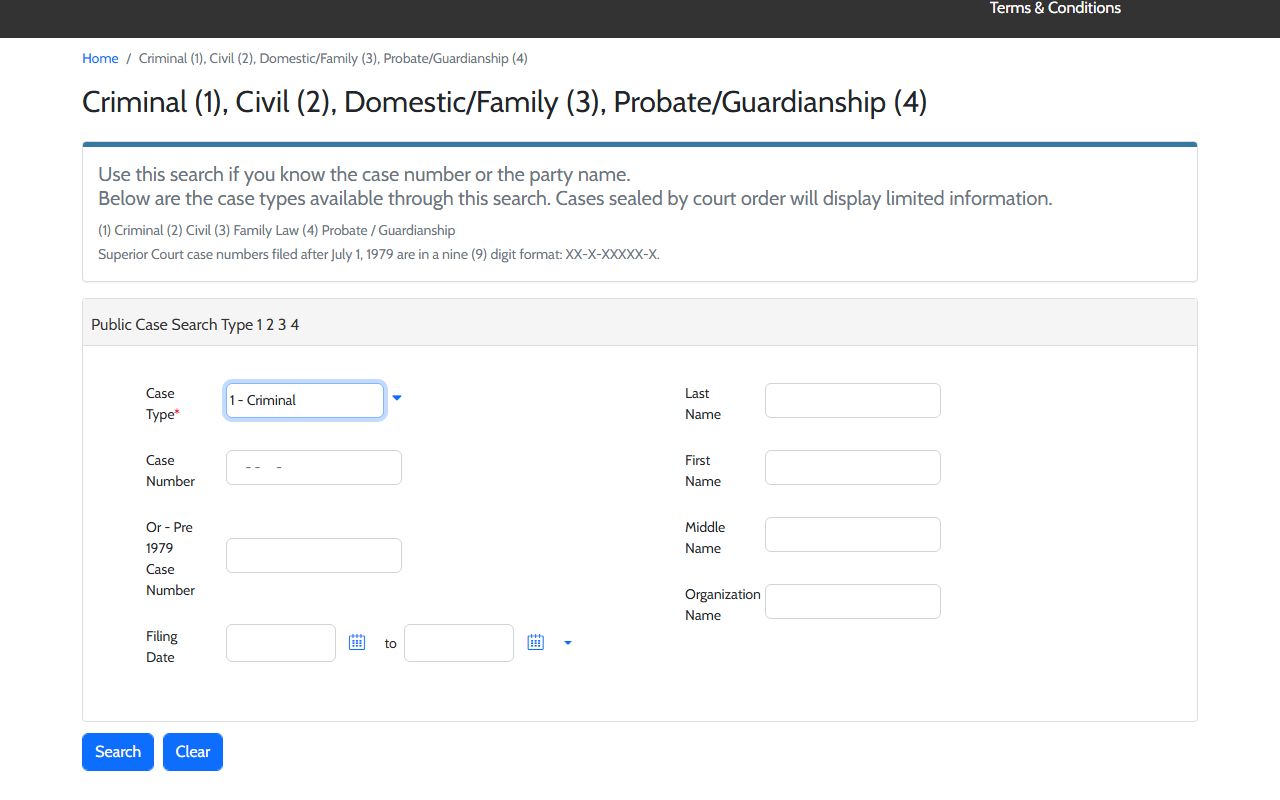
District Court name searches work differently. Since April 2024 you choose Criminal and Infraction or Civil, and you add a filing-date range up to 365 days when the exact date is unknown.
Types of King County Court Records
Court records fall into a handful of broad groups. Each group can sit in Superior Court, District Court, or a city municipal court, depending on the charge or claim and the agency that filed it.
Civil files include lawsuits, evictions, judgments, and small claims. Criminal files run from felonies in Superior Court to misdemeanors in District Court. Family files cover divorce, custody, and parentage. Probate files cover estates and guardianships. Traffic and parking sit mostly in District and municipal courts.
- Civil lawsuits, protection orders, and unlawful detainer cases.
- Criminal felony and misdemeanor case files.
- Family law, divorce, and parentage matters.
- Probate, guardianship, and will repository records.
Municipal courts add another layer. A Seattle city misdemeanor or parking ticket may sit in Seattle Municipal Court rather than King County District Court, so an empty District Court result does not always mean no case exists. Always check the court named on the citation or notice. For deeper detail on each type, see the arrest records, court dockets, and traffic court records pages.
What King County Court Records Show
Every case file is made of fields. Some you can search, some you only see inside the record, and some are hidden for privacy. The table lists the fields you meet most often in a King County court record.
| Field | What It Shows |
|---|---|
| Case Number | The cause number tracking the case; Superior Court uses XX-X-XXXXX-X |
| Case Type | Criminal, civil, domestic, probate, parentage, or another category |
| Filing Date | When the case opened with the court |
| Parties | Plaintiff, defendant, petitioner, respondent, or organization |
| Docket Entries | The list of filings, motions, orders, and hearings |
| Disposition | The outcome, such as dismissed or judgment entered |
| Documents | Pleadings and orders, viewable or orderable for a fee |
District Court results add hearing dates, sentence conditions, warrant status, and protection-order status. Both portals withhold addresses, phone numbers, and dates of birth under GR 31.
Public Access Framework for King County Court Records
Washington separates agency records from court records. Agency records, such as a police report or county email, follow the Public Records Act in chapter 42.56 RCW. Court case files follow court rules, mainly GR 31, which says the public may access court records except where law, rule, or order restricts them. The PRA policy in RCW 42.56.030 directs broad access to agency records and narrow exemptions.
Anyone can search basic case information for free, and the Clerk keeps public access terminals where you can view documents at no cost during business hours. Online downloads and certified copies carry per-page fees. A fee waiver is available for people who qualify and, once approved, can last 12 months.
Note: Online case data is informational only; an official certified record must be ordered through the Superior Court Clerk under the court's records-access process.
Records That Are Sealed or Confidential in King County
Some King County court records are closed to the public. Adoption files are confidential under RCW 26.33.330. Juvenile dependency records are restricted under RCW 13.50.100, and juvenile offender sealing follows RCW 13.50.260. Mental health and involuntary treatment records are limited under RCW 71.05.620. Sealing and redaction of any court record follow GR 15, which requires a judge to make findings before access is restricted.
To view a sealed file, an eligible party appears in person with current government photo ID, or files a KC Script request and meets the Clerk over video to verify identity. The Clerk must confirm your authority to access the case. With some confidential cases the Clerk cannot even confirm that the case exists, and sealed documents cannot be mailed without a court order.
Mental health and involuntary treatment records are a clear example of statute-based confidentiality.
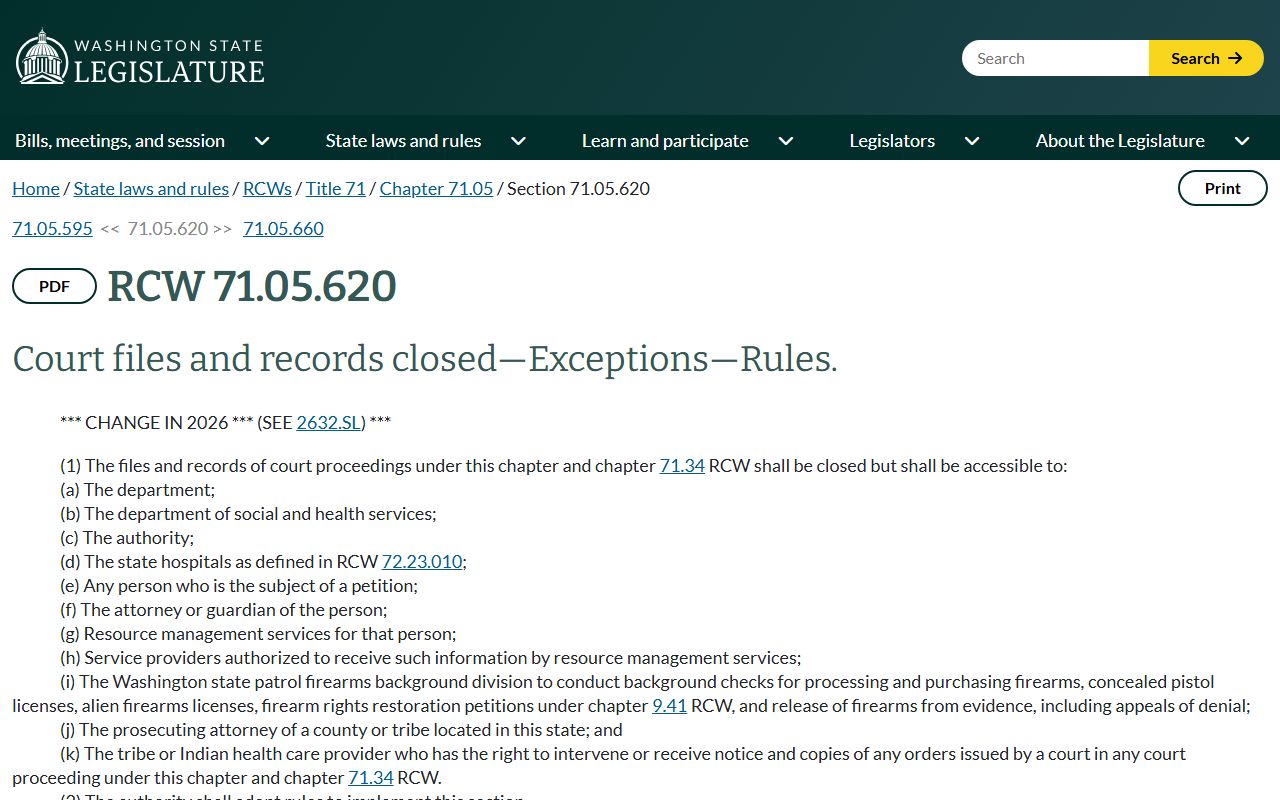
Those records are limited under RCW 71.05.620, which the Clerk lists among its sealed and confidential examples.
In-Person Court Record Requests
If a record is not online, or you need a certified copy, you can work with the Clerk directly. The Superior Court Clerk keeps public records access areas at the courthouse where you can view documents for free during business hours. Bring photo ID, the case number if you have it, and a way to pay copy fees.
Superior Court Clerk / DJA
King County Courthouse
516 Third Avenue, Room 609
Seattle, WA 98104
206-296-9300
Mon-Fri 9:00 a.m. to 4:30 p.m.
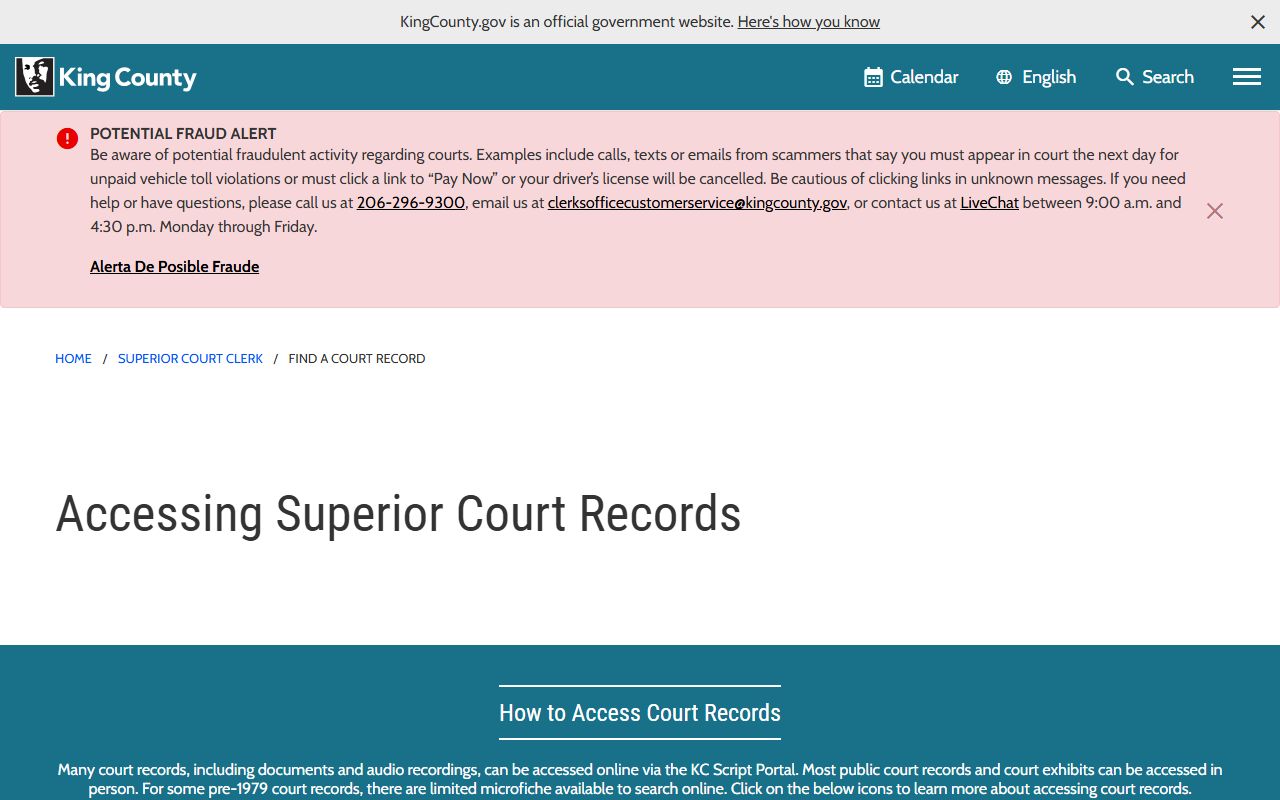
The Clerk's records-access page, shown above, covers account setup, the 14-day download window, sealed-record steps, and fee waivers.
King County Court Records Fees and Copies
Searching is free, but copies are not. The Superior Court Clerk sets per-page rates that depend on the copy type. Online viewing of eligible records is the cheapest path. Clerk-assisted copies cost more, and certified copies carry a first-page fee plus a per-page charge. Research help is billed by the hour.
| Item | Amount |
|---|---|
| Online view or download per page | $0.25 |
| Clerk-assisted non-certified copy per page | $0.50 |
| Certified copy | $5 first page, $1 each additional |
| Exemplified copy | $9 first page, $1 each additional |
| Research fee | $30 per hour or any part of an hour |
| Audio hearing recording | $25 per cause number, up to 72 minutes |
Completed orders stay available in the portal for 14 calendar days. To order a certified copy, follow these steps.
- Create or log in to a KC Script account.
- Search the case and open the Documents tab.
- Select the documents you need and add them to your order.
- Pay the fee, or submit a Fee Waiver Request if you qualify.
- Download the completed record within the 14-day window.
An approved fee waiver gives free access, including certified copies, for 12 months. The Superior Court Clerk page covers the waiver workflow in full.