
Where King County Marriage and Divorce Records Live
The first step is matching the record to the office. Marriage licensing and marriage certificates are handled by the King County Recorder's Office, part of Records and Licensing Services. Divorce cases are Superior Court family law records, held by the Superior Court Clerk and searchable through KC Script. The two offices do not share a single file.
This matters when you order a copy. A marriage certificate comes from the Recorder. A divorce decree comes from the Clerk. Asking the wrong office only adds delay. The two offices also sit in different buildings, so knowing which one you need saves a trip as well as a phone call. When in doubt, match the record to the event: a wedding produces a Recorder document, while a court case produces a Clerk document.
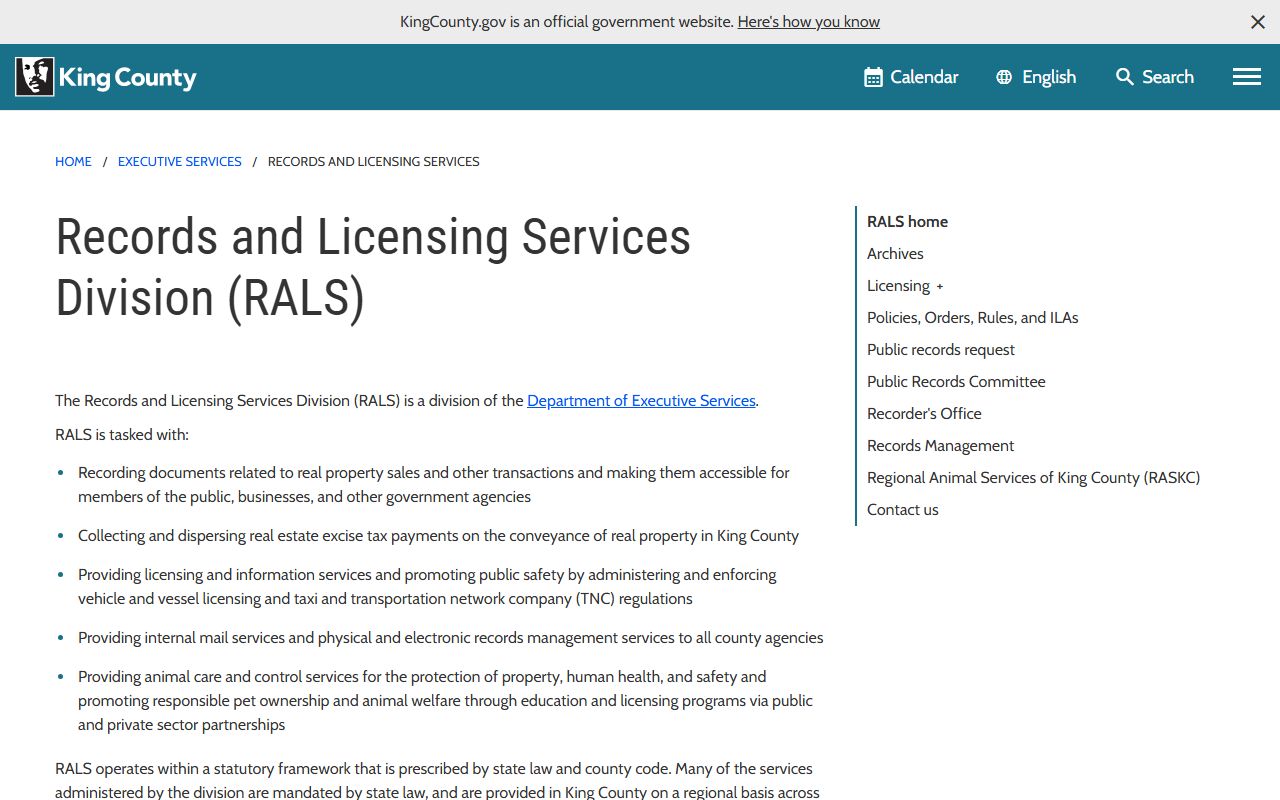
The Records and Licensing Services division oversees the Recorder's Office and marriage records.
King County Marriage License Requirements
The Recorder's Office issues marriage licenses. The application should use each applicant's current full legal name, not an intended married name, and it must include at least one daytime phone number. If you apply by mail, the application must be notarized. The office warns applicants not to wait until the last minute, because it cannot guarantee a three-day turnaround during peak periods.
| Field Label | Type | Required | Notes / Format |
|---|---|---|---|
| Applicant A full legal name | Text | Yes | Current name, not married name |
| Applicant B full legal name | Text | Yes | Current name, not married name |
| Mailing address | Text | Yes | Physical address; no P.O. box |
| Daytime phone | Phone | Yes | At least one number |
| Notary acknowledgment | Notary block | For mail | Application must be notarized |
| Signature | Signature | Yes | Original signed application; no scanned affidavit |
| Fee | Payment | Yes | $169 payable to King County by mail |
A few details trip people up. The application must reflect current full legal names, not the name either person plans to use after marriage. An original signed application is required, and a scanned or faxed affidavit is not accepted. If applying by mail, the check or money order must include an address, and starter checks are not accepted. The packet is returned by USPS Priority Mail or FedEx once processed, so a physical return address is required and a P.O. box will not work. The official instructions and the direct application link sit on the King County marriage licensing page.
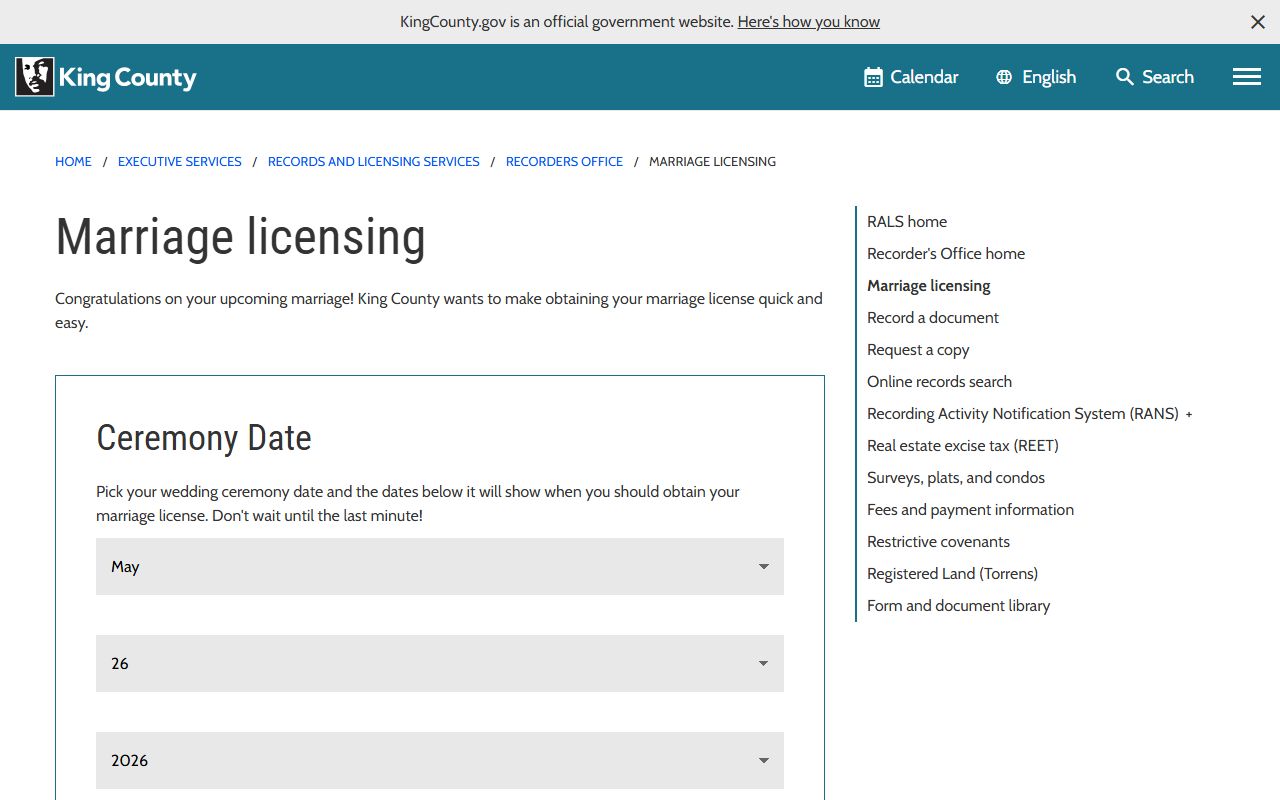
That page lists the Recorder's hours, phone, and mailing guidance for the application packet.
How to Apply for a King County Marriage License
Applying is straightforward if you follow the steps in order. The biggest mistakes are using a future married name and missing the notary requirement for mail applications.
- Download and complete the King County marriage license application.
- Use current legal names and print legibly or type.
- Have the application notarized if you are not applying in person as instructed.
- Include a daytime phone and a physical return address.
- Enclose a $169 check or money order payable to King County if applying by mail.
- Wait for the packet, since the office cannot promise a three-day turnaround.
After the license issues, the ceremony and return rules take over, covered below.
King County Marriage Record Fees
The marriage fees are simple and fixed. The license itself is the main cost, and certified certificate copies are inexpensive. Replacement of a lost or damaged document before the wedding carries a small per-document charge.
| Item | Amount |
|---|---|
| Marriage license (by mail) | $169 |
| Certified marriage certificate copy | $3 each |
| Replacement of lost or damaged document | $1 per document |
By mail, pay with a check that has a preprinted name and address, a money order, or a cashier's check payable to King County Records. Starter checks are not accepted. In person, cash or debit and credit are accepted.
Ceremony and Return Rules
A license is only the start. After the ceremony, the couple, the officiant, and at least two witnesses must sign the license. The officiant then completes the marriage certificate and returns it to King County within 30 days of the ceremony. If a ceremony happens without a valid license, it is not legally recognized for civil purposes, and the couple must buy a license and hold another ceremony within the valid dates.
Washington marriage rules, including officiant and ceremony requirements, come from a state statute.
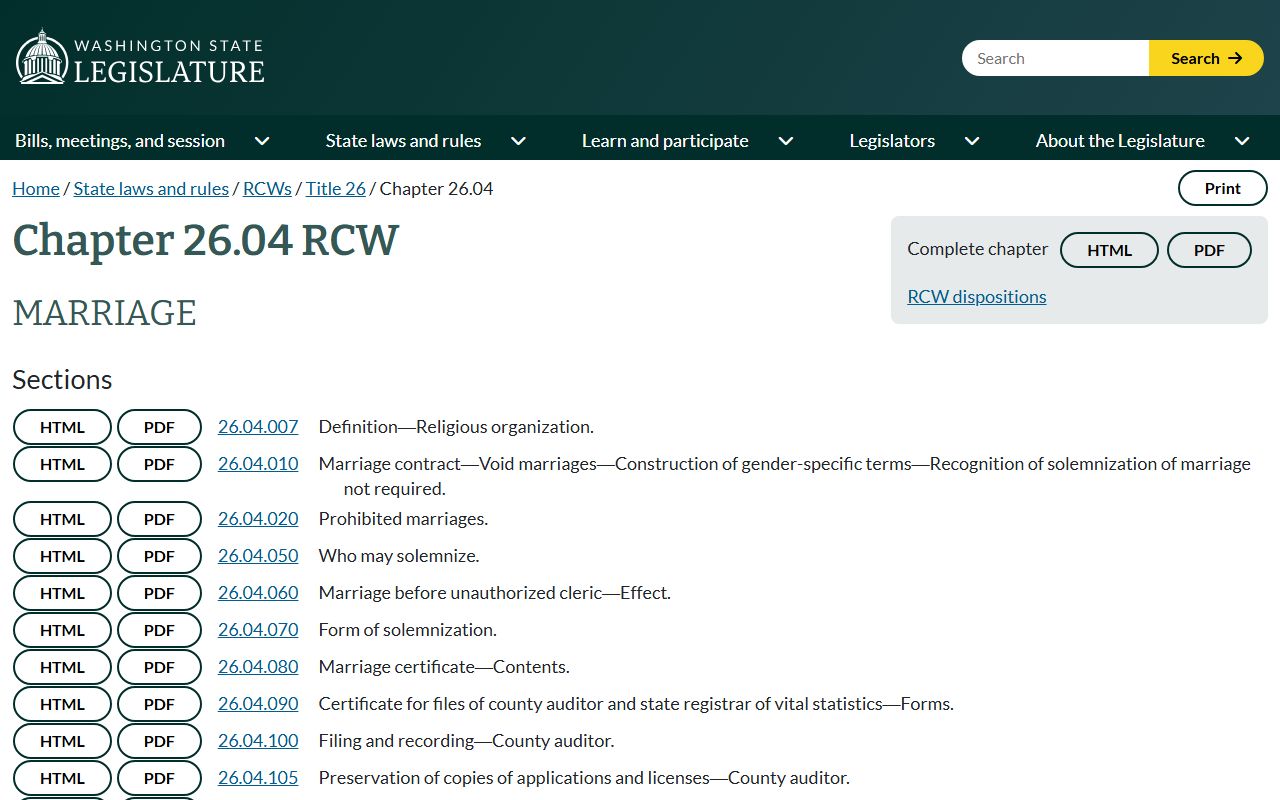
The framework is set in chapter 26.04 RCW, the Washington marriage statutes.
Certified Marriage Copies
Once the certificate is returned and recorded, certified copies become available, usually about 10 business days after the record comes back. Search the county's online records first, and if the record shows the document type Marriage Certificate, you can request a copy. Marriages before 1991 can be requested from the Washington State Digital Archives instead.
You can order certified copies in three ways: by phone at 206-477-6620 weekdays from 9 a.m. to 2 p.m., by mail to King County Marriage Records at 500 Fourth Avenue, Room 430, Seattle, WA 98104, or in person. Certified copies are $3 each.
If a license or certificate is lost or damaged before the wedding, the office can replace documents for $1 each, and a mailed affidavit of loss must be notarized. A scanned or faxed affidavit is not accepted in place of an original signed and notarized document. Plan ahead, because the office cannot guarantee a fast turnaround during busy periods, and a returned certificate takes about 10 business days to become available as a certified copy.
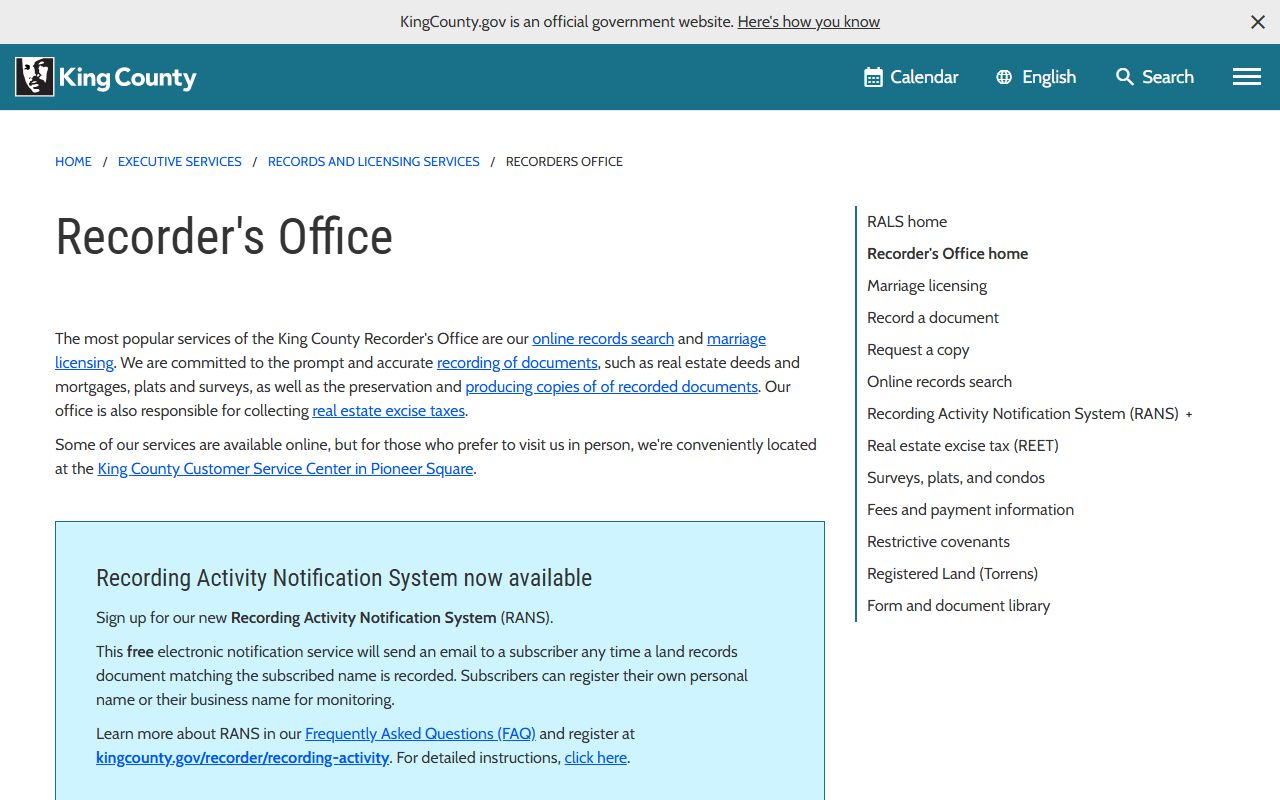
The Recorder's Office records page explains copy requests and recorded documents.
King County Divorce Records
Divorce is different. A divorce, called a dissolution in Washington, is a Superior Court family law case, not a Recorder's Office record. Search it in KC Script as Family or Domestic Case Type 3. You can search by case number, party name, or filing date, the same way you search any Superior Court case.
Filing a divorce requires proper Washington venue and jurisdiction, and cases proceed through the Superior Court with forms, service, temporary orders, and a final decree. To search or follow a case, use the court records process, and for help reading the case timeline, see court dockets.
A King County divorce moves through a familiar set of steps, and the case record grows at each one.
- File the dissolution case in King County Superior Court if venue and jurisdiction are proper.
- Use Superior Court family law forms and e-filing through KC Script where allowed.
- Pay the filing fee or request a fee waiver.
- Serve the other party and file proof of service.
- Resolve temporary orders, a parenting plan, child support, and property and debt.
- Enter the final decree, then search or request copies through KC Script Case Type 3.
Certified Divorce Decrees
A certified copy of a divorce decree comes from the Superior Court Clerk, not the Recorder. Order it through KC Script or in person at the Clerk's records access area. Standard Clerk copy fees apply: certified copies are $5 for the first page and $1 for each additional page. A fee waiver is available for people who qualify.
Full Clerk request steps and the fee schedule are on the Superior Court Clerk page.
Family Law Confidentiality
Some family records carry extra protection. Parentage and paternity cases are restricted, and access can be limited even though KC Script has a parentage search category. Adoption records are confidential under RCW 26.33.330. Sealed portions of a divorce file, or confidential financial and child information, may require identity verification and eligibility before the Clerk releases them.
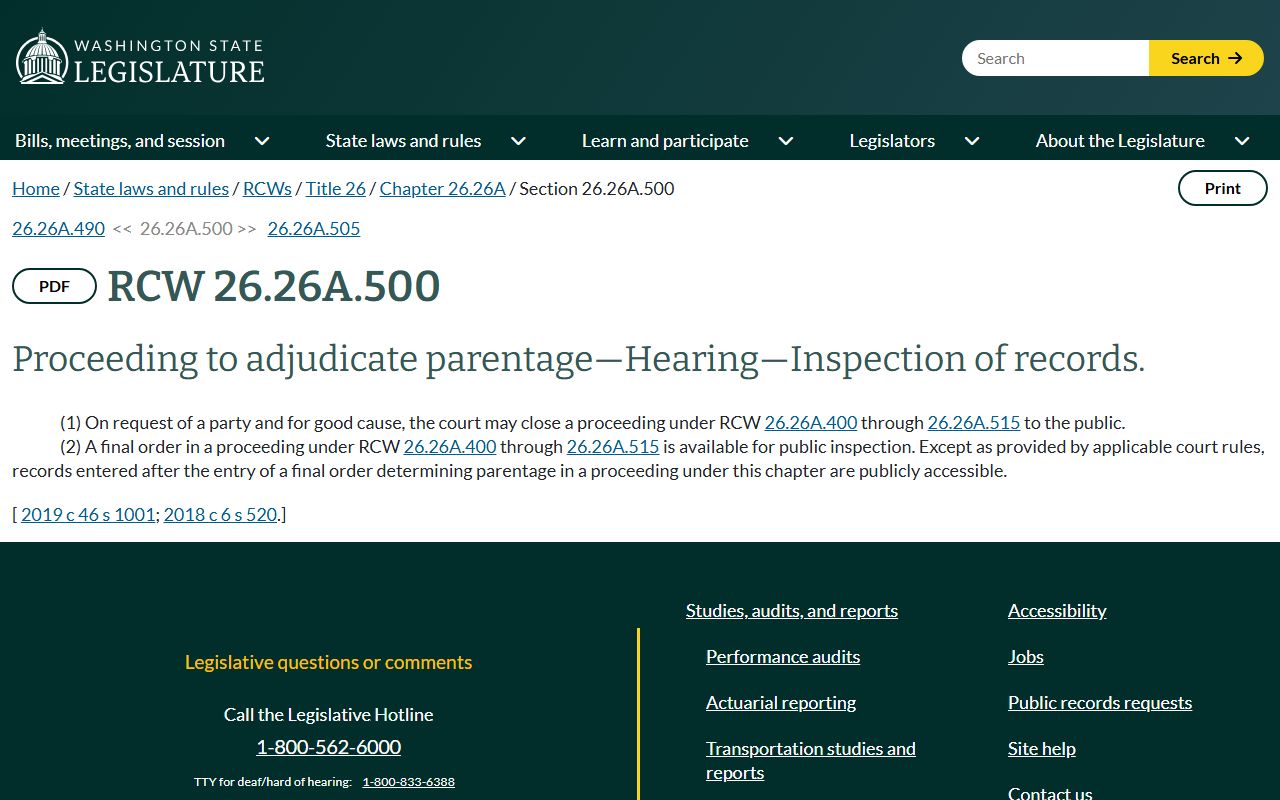
Parentage confidentiality is set by RCW 26.26A.500, which the Clerk cites for limiting access to paternity and parentage records.
Note: A marriage certificate copy comes from the Recorder, while a divorce decree copy comes from the Superior Court Clerk; the two are separate offices.
Other Recorded Documents at the Recorder's Office
The Recorder's Office handles more than marriage records. It records and provides copies of real-property documents, liens, military separations, and other recorded instruments, none of which are court case files. This is the line between the Recorder and the Clerk. The Recorder holds recorded documents and marriage records, while the Clerk holds Superior Court case records such as divorce decrees, probate orders, and civil filings.
Because the two offices overlap in the public's mind, requests often go to the wrong counter. If you need a recorded deed or a marriage record, the Recorder is the office. If you need a filed court document, the Clerk is the office. The Recorder's Office page covers recorded documents in detail, and the probate records page covers estate filings held by the Clerk.