
King County Superior Court Jurisdiction
Superior Court is a court of general jurisdiction, which means it can hear almost any kind of civil or criminal case. In King County, it handles felony criminal cases, major civil suits, family law and divorce, juvenile matters, dependency, guardianship, probate, unlawful detainer, and appeals from the courts of limited jurisdiction. Felony prosecutions reach Superior Court after the King County Prosecuting Attorney files charges.
This breadth is why so many important records live here. A divorce, an estate, a felony, and a major lawsuit all share the same trial court, and the Superior Court Clerk keeps every one of those files. As the most populous county in Washington, King County carries one of the heaviest superior-court caseloads in the state, which is part of why the court spreads its work across several locations and a large set of judges and commissioners.
King County Superior Court Locations
Superior Court runs from three main locations, plus a specialized treatment calendar. The downtown King County Courthouse is the central seat, the Maleng Regional Justice Center serves the south county, and the Children and Family Justice Center handles juvenile and family work. An Involuntary Treatment Act calendar sits at Harborview Medical Center.
King County Courthouse
516 Third Avenue
Seattle, WA 98104
206-296-9300
Maleng Regional Justice Center
401 Fourth Avenue N
Kent, WA 98032
206-296-9300
Clark Children & Family Justice Center
1211 E. Alder Street
Seattle, WA 98122
206-296-9300
The downtown courthouse also houses the Superior Court Clerk and the Prosecuting Attorney, which makes it the hub for most Superior Court records business.
Superior Court Divisions and Work
Within Superior Court, the work groups into broad areas, and each produces its own kind of record. The criminal side handles felony charges filed by the Prosecuting Attorney, from arraignment through sentencing. The civil side handles major lawsuits, evictions, and judgments. The family side handles divorce, custody, child support, and parentage. The probate side handles estates, wills, and guardianships through the Ex Parte and Probate Department.
Superior Court also carries specialized operations for children and families, including dependency and juvenile matters at the Children and Family Justice Center, plus the Involuntary Treatment Act calendar at Harborview. Because the same court spans so many areas, the case type is what tells you which division, and which search category, holds the record you want. A divorce and a felony may share a courthouse, but they sit in different parts of the system.
How a King County Case Moves Through the Courts
Washington courts run in a clear order, and a case can move upward on appeal. Limited-jurisdiction courts handle the smaller matters, Superior Court handles the larger ones and hears appeals from below, and the appellate courts review Superior Court decisions.
Case flow: District or Municipal Court › Superior Court › Court of Appeals, Division I › Washington Supreme Court
King County sits in Division I of the Court of Appeals, based in Seattle. An appeal from District or municipal court can route to Superior Court, while an appeal from Superior Court routes to the Court of Appeals and potentially the Supreme Court.
Superior Court vs District Court vs Municipal Court
The three trial-court levels split the work by case type and seriousness. The comparison shows which court hears what, so you know where a record lives.
| Court | Jurisdiction | Typical Cases |
|---|---|---|
| Superior Court | General | Felonies, divorce, probate, guardianship, juvenile, major civil |
| District Court | Limited | Misdemeanors, traffic, small claims, name changes, limited civil |
| Municipal Court | City | City ordinance, parking, traffic, city misdemeanors |
A felony goes to Superior Court. A misdemeanor may go to District Court or a city municipal court. A Seattle city case usually sits in Seattle Municipal Court, not King County District Court.
This split is the single most useful thing to understand about King County courts. Many people search Superior Court for a case that never went there, or check District Court for a city ticket that belongs to a municipal court. The absence of a result in one system does not prove no case exists; it may only mean the case lives in another court. The court named on the ticket, summons, citation, or notice is the most reliable guide to where the record sits.
King County District Court
District Court is the county's high-volume limited-jurisdiction court. It says it has 25 elected judges who hear civil and criminal cases at 10 locations. It handles misdemeanors, gross misdemeanors, traffic infractions, small claims, limited civil cases, name changes, impound hearings, and protection orders. Some District Court locations also provide municipal court services for cities by contract.
District Court keeps its own portal and records, separate from Superior Court. Its case-access resources explain what the portal shows for filed cases.
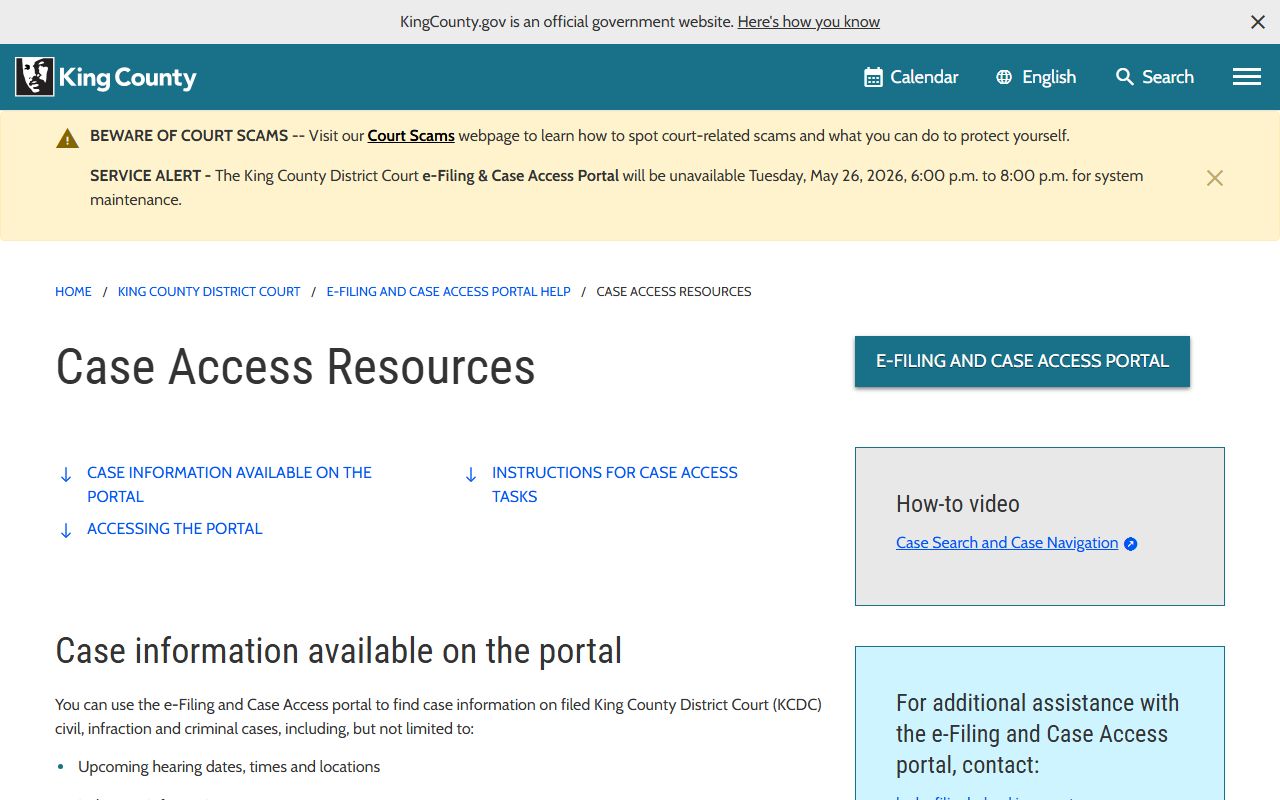
The District Court case access resources page lists the hearing, judgment, sentence, warrant, and document-index data available online.
King County District Court Locations
District Court is organized into East, South, and West divisions. The table lists the main locations with their addresses and phone, which is the practical map for filing and hearings outside Superior Court.
| Location | Address | Phone |
|---|---|---|
| Office of Presiding Judge | 516 Third Avenue, Room W-1034, Seattle, WA 98104 | 206-477-1720 |
| Auburn | 340 E Main St 101, Auburn, WA 98002 | 206-205-9200 |
| Bellevue | 1309 114th Ave SE, Suite 100, Bellevue, WA 98004 | 206-205-9200 |
| Burien | 601 SW 149th St, Burien, WA 98166 | 206-205-9200 |
| Issaquah | 5415 220th Ave SE, Issaquah, WA 98029 | 206-205-9200 |
| MRJC / Kent | 401 4th Ave N, Office 1A, Kent, WA 98032 | 206-205-9200 |
| Redmond | 8601 160th Ave NE, Redmond, WA 98052 | 206-205-9200 |
| Seattle | 516 Third Avenue, Room E-327, Seattle, WA 98104 | 206-205-9200 |
| Shoreline | 18050 Meridian Ave N, Shoreline, WA 98133 | 206-205-9200 |
| Vashon | 10011 SW Bank Road, Vashon, WA 98070 | 206-205-9200 |
Burien is the south civil and small-claims filing area, and Redmond is the east civil filing area. The Vashon location is operated with Burien and is open only one day per month. Some Seattle calendars are heard at the correctional facility on Fifth Avenue rather than only in the courthouse room, so check the specific notice on your case.
District Court Case Access and E-Filing
District Court uses an e-Filing and Case Access portal for its cases. Public access accounts are free, but anonymous case access and e-filing are not allowed. Paying a ticket does not require an account. Since April 2024, name searches require choosing Criminal and Infraction or Civil, plus a filing-date range when the exact date is unknown.
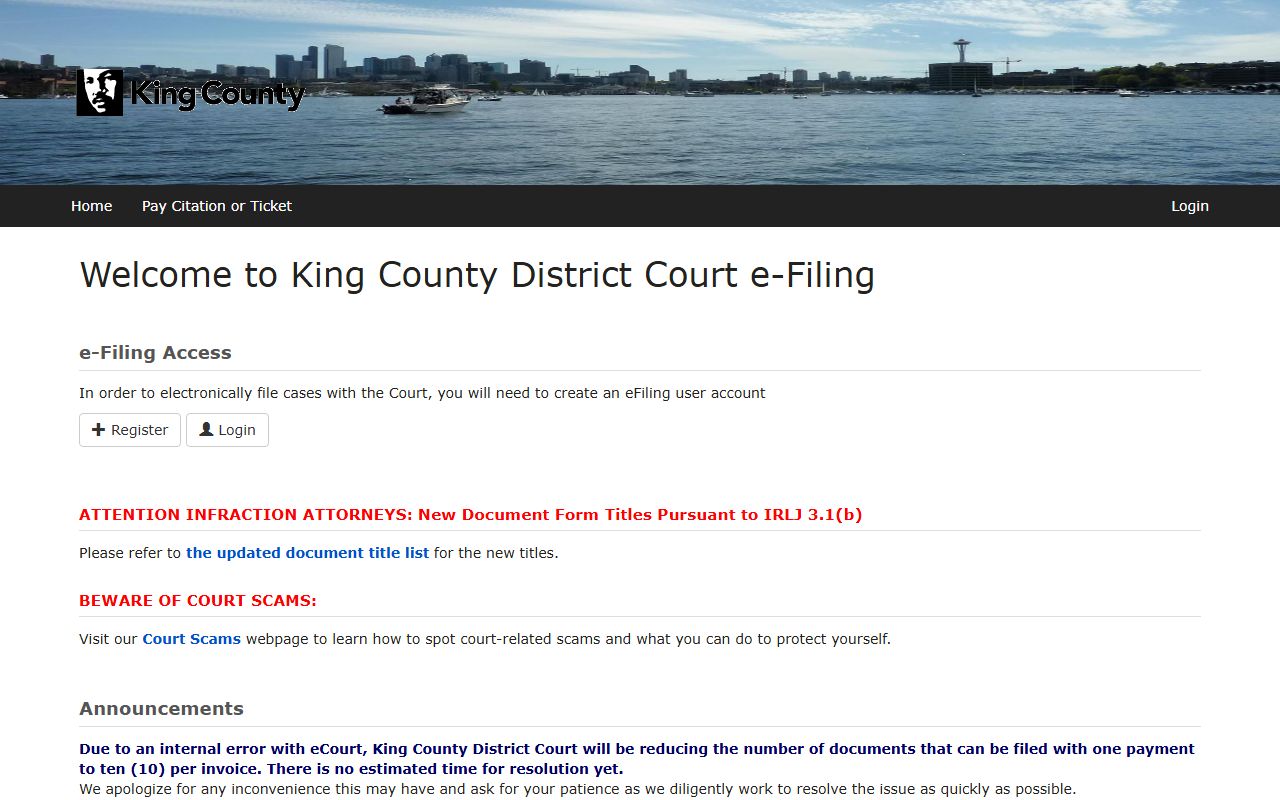
The District Court e-Filing and Case Access portal posts login rules, maintenance windows, and support contacts. Accounts not used in 12 months are deactivated.
A few practical notes help with the District Court portal. It runs a regular maintenance window early on Sunday mornings, so a failed search at that hour may simply be downtime. The portal also warns that Microsoft Edge can struggle to display PDFs and court stamps, and it recommends Google Chrome when a document will not open. For technical access problems or account reactivation, the court provides a dedicated e-filing help email. These small details often explain a search that seems broken when the underlying record is fine.
Local Rules and Court Forms
Both court levels publish rules and forms that shape how cases proceed. District Court posts local rules, including small-claims and local civil rules, while statewide forms are kept by the Washington Courts.
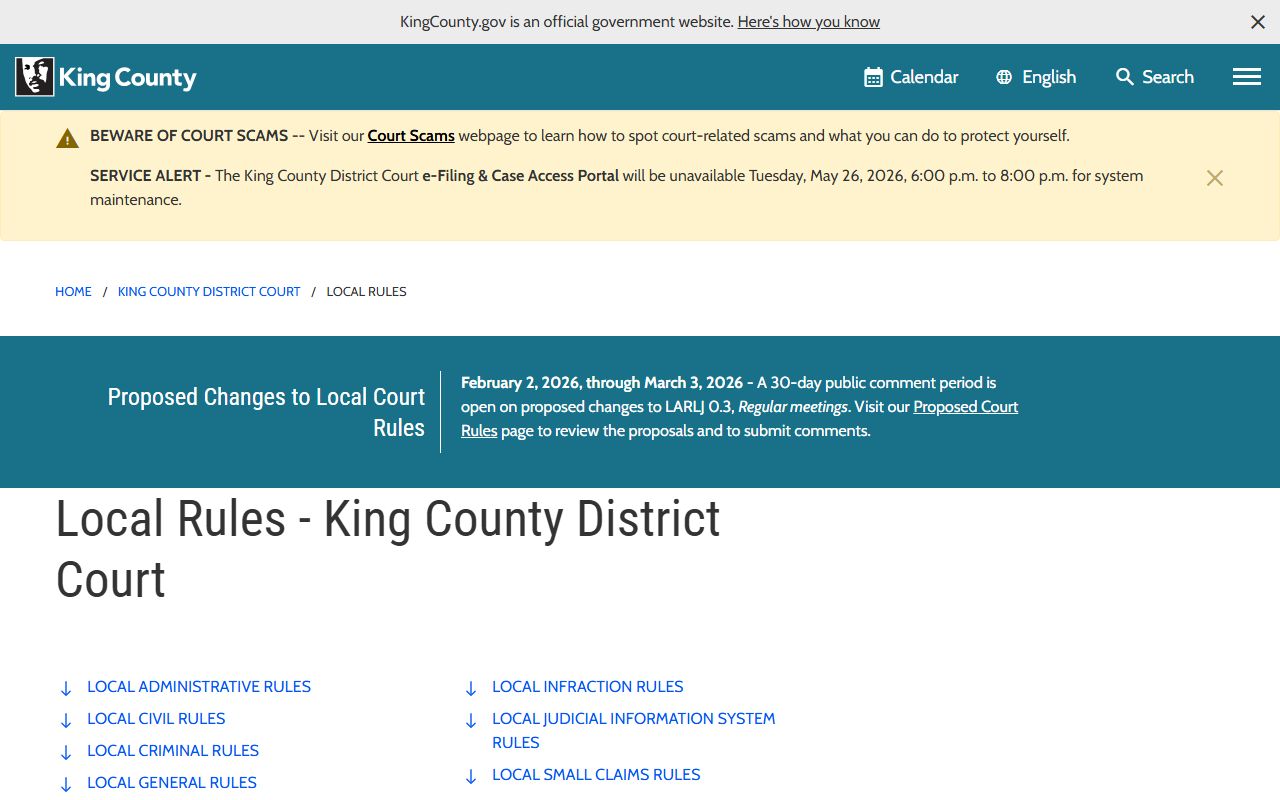
The District Court local rules page covers small-claims and civil procedure. Statewide forms for many case types are available too.
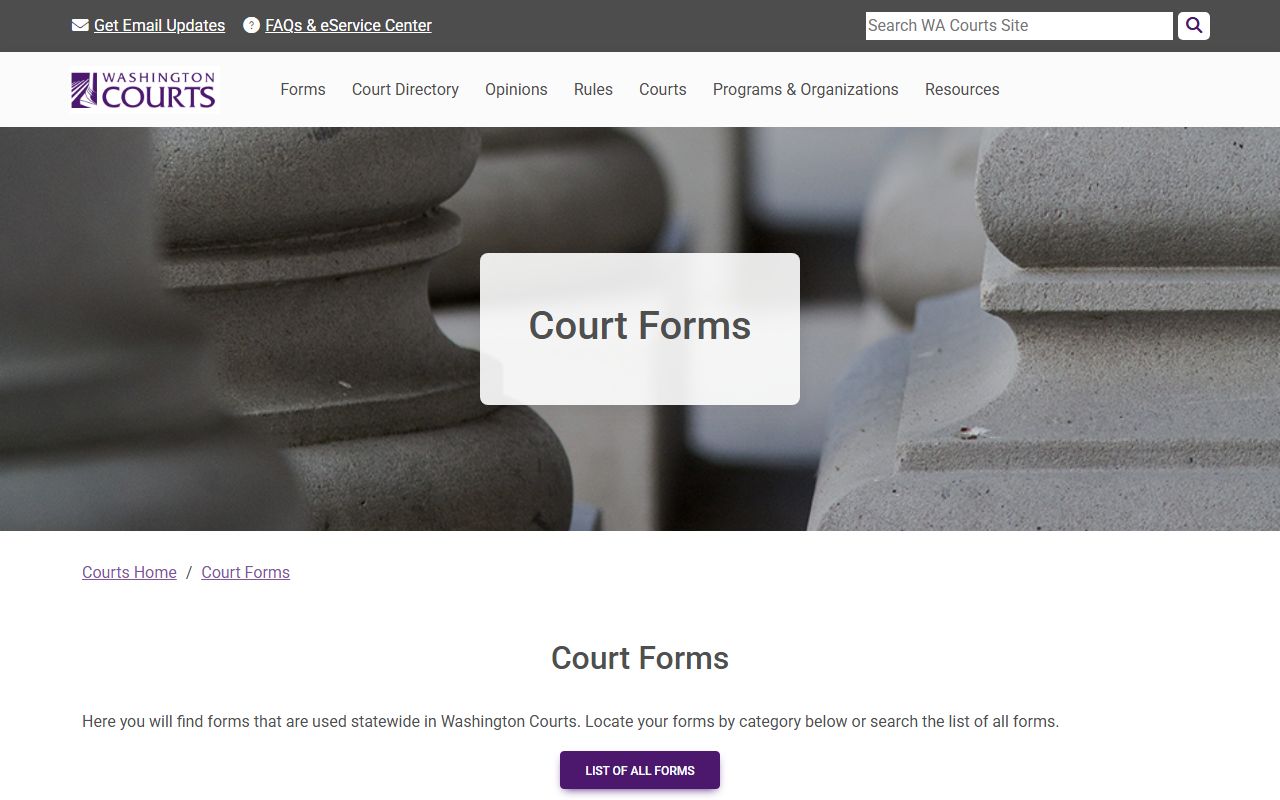
The Washington Courts forms library provides forms used in Superior and District courts statewide.
Specialty Courts and Programs
The county runs problem-solving courts that handle specific needs. District Court lists a Regional Veterans Court, a Regional Mental Health Court, a Domestic Violence Court, and Community Courts. Superior Court adds Dependency Court, Family Court Services, Juvenile Court Services, and the Involuntary Treatment Act calendar at Harborview. These programs use review hearings and treatment plans rather than ordinary case processing.
To search the records these courts generate, use the right portal: court records through the Clerk for Superior Court, and the District Court portal for limited-jurisdiction cases. The Superior Court Clerk page covers copies and certified records. Specialty courts often connect participants with treatment and community services, so their files can include compliance reports and review-hearing entries that a routine case would not have.