
How to Search King County Court Records
The search path depends on the case type. Felonies, divorce, family law, probate, guardianship, juvenile matters, and Superior Court search warrants live in King County Superior Court. The Superior Court Clerk, also called the Department of Judicial Administration, runs an online portal named KC Script. Misdemeanors, traffic tickets, small claims, name changes, and many limited civil cases live in King County District Court, which uses its own e-Filing and Case Access portal. Pick the right court first. A search in the wrong system returns nothing even when a real case exists.
Have a few things ready before you start. A full party name helps, and a case number helps more. Superior Court case numbers filed after July 1, 1979 use the format XX-X-XXXXX-X. If you only have a name, plan to narrow your search by filing date.
- Decide whether the case is Superior Court or District Court.
- Open KC Script for Superior Court, or the District Court Case Access portal for District Court.
- Choose the case type, then search by case number or party name.
- Set a filing-date range to cut down a long list of name matches.
- Open the docket, then request a certified copy from the Clerk if you need an official record.
The Superior Court's main landing page explains the court's jurisdiction and lists its program areas, and you can review it through the King County Superior Court page. The page gives a useful overview before you open the records portal.
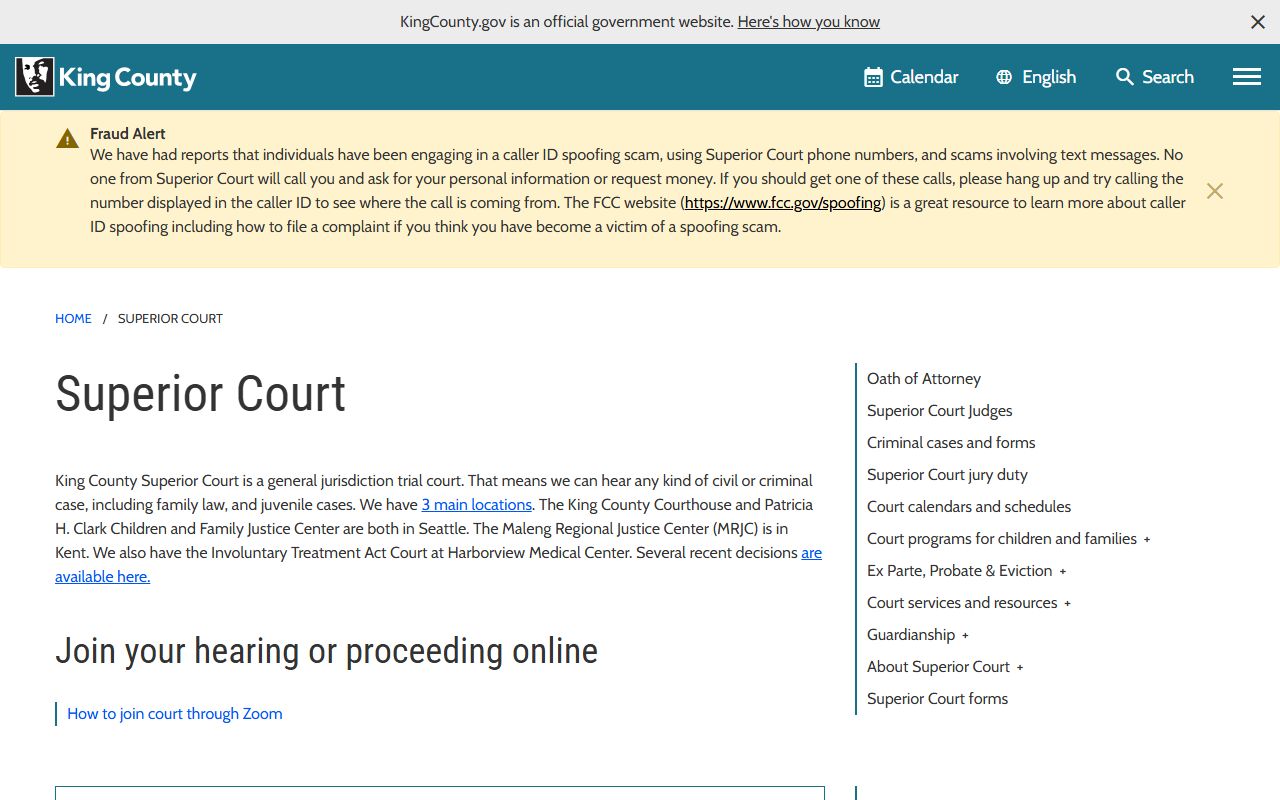
That landing page is also where the court links family, juvenile, probate, and protection-order resources, so it doubles as a map of the Superior Court's work.
The King County Judicial System
Washington courts run in a clear order. The Washington Supreme Court sits at the top. Below it is the Court of Appeals, and King County falls in Division I, based in Seattle. The general trial court is the Superior Court, which hears the most serious and the most complex cases. Below that is the District Court, a court of limited jurisdiction. City municipal courts sit alongside District Court and handle city ordinance cases.
King County District Court says it has 25 elected judges who hear civil and criminal cases at 10 locations. Superior Court has three main locations plus an Involuntary Treatment Act calendar at Harborview Medical Center. The Washington court directory shows how each county fits the statewide structure.
Case flow: District or Municipal Court › Superior Court › Court of Appeals, Division I › Washington Supreme Court
| Court | Jurisdiction | Case Types |
|---|---|---|
| Superior Court | General jurisdiction | Felonies, divorce, probate, guardianship, juvenile, major civil |
| District Court | Limited jurisdiction | Misdemeanors, traffic, small claims, name changes, limited civil |
| Municipal Courts | City jurisdiction | City ordinance, parking, traffic, city misdemeanors |
| Court of Appeals, Division I | Appellate | Appeals from Superior Court |
You can confirm the layout through the Washington State Court Directory, which lists courts and contacts by county.
The directory is handy when a case may belong to a court outside the county or to an appellate division. The state courts also publish a plain-language structure guide.
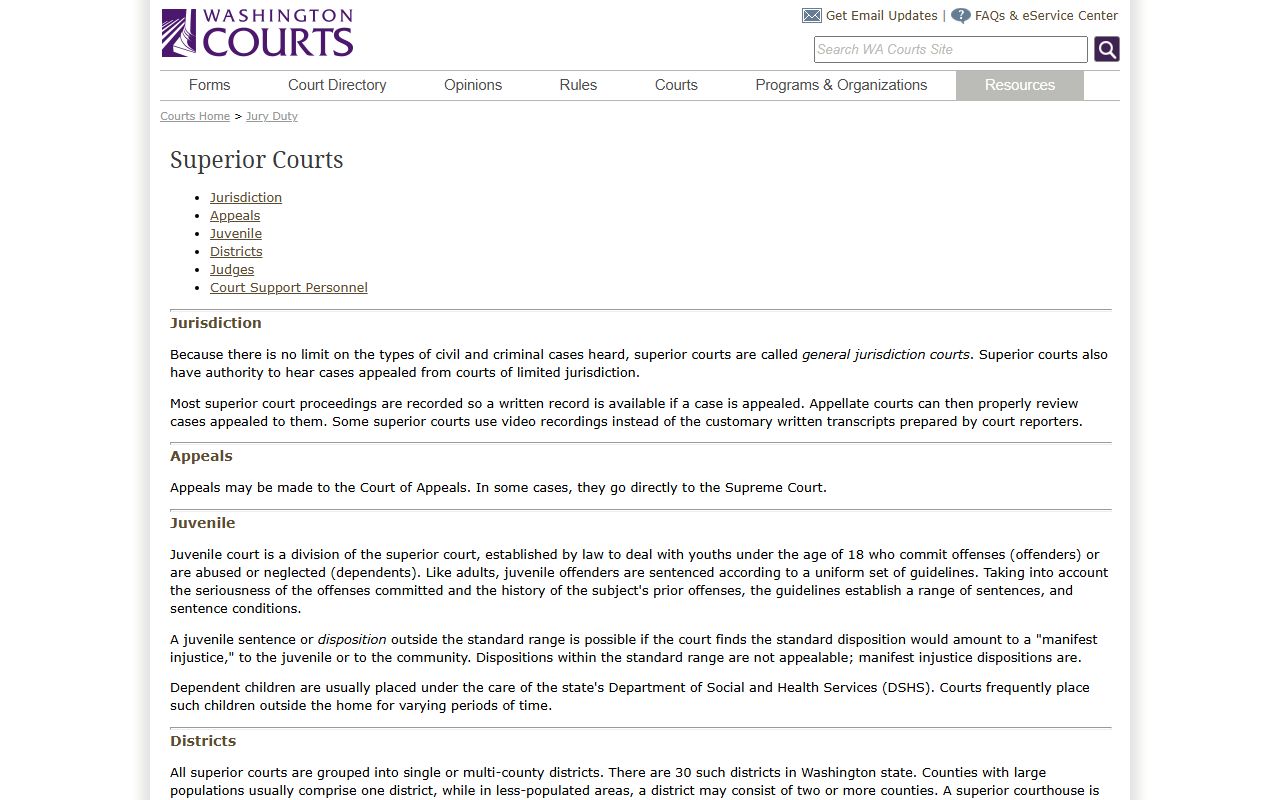
That Washington Courts structure guide explains the county clerk role and how Superior Court fits the statewide system.
King County Superior Court Records
Superior Court records are managed by the Clerk through KC Script. The portal lets you view, request, and purchase King County Superior Court records, but it warns that the online data is not the official record and may contain errors or omissions. Information can take up to three court days to appear after a filing or hearing. For an official copy you order through the Clerk. The portal covers adult criminal, civil, all family law, probate and guardianship, and unsealed portions of parentage cases for filings from November 2004 forward.
The Case Search menu groups Superior Court records into types. Criminal is Case Type 1, civil is Case Type 2, family or domestic is Case Type 3, and probate or guardianship is Case Type 4. Separate categories cover parentage, juvenile offender, judgments, land title, search warrants, the will repository, and sealed or confidential cases. For the first four types, you can search by case number, party name, or filing date.
| Field Label | Type | Required | Notes / Format |
|---|---|---|---|
| Case Type | Dropdown | Yes | 1 Criminal, 2 Civil, 3 Domestic, 4 Probate/Guardianship |
| Case Number | Text | No | Post-1979 format XX-X-XXXXX-X |
| Filing Date | Date range | No | Presets such as last 10 days, this month, this year |
| Last / First / Middle Name | Text | No | Party or person name search |
| Organization Name | Text | No | Use for business parties |
Cases sealed by court order show only limited information, and cases that are confidential by statute cannot be searched at all. More detail on each category sits on the King County court records page.
King County District Court Records
District Court keeps a separate set of records and a separate portal. The e-Filing and Case Access system can show filed civil, infraction, and criminal cases. You can see upcoming hearing dates, judgment information, conditions of sentence, warrant status, protection order status, and an index of documents filed. Search by case number, name, date of birth, company name, or filing date. Public access accounts are free, but anonymous case access and e-filing are not allowed. Paying a ticket does not require an account.
Name searching changed in April 2024. You now choose Criminal and Infraction or Civil, and you add a filing-date range of up to 365 days when you do not know the exact date. The portal does not publish addresses, phone numbers, dates of birth, or other personal identifiers.
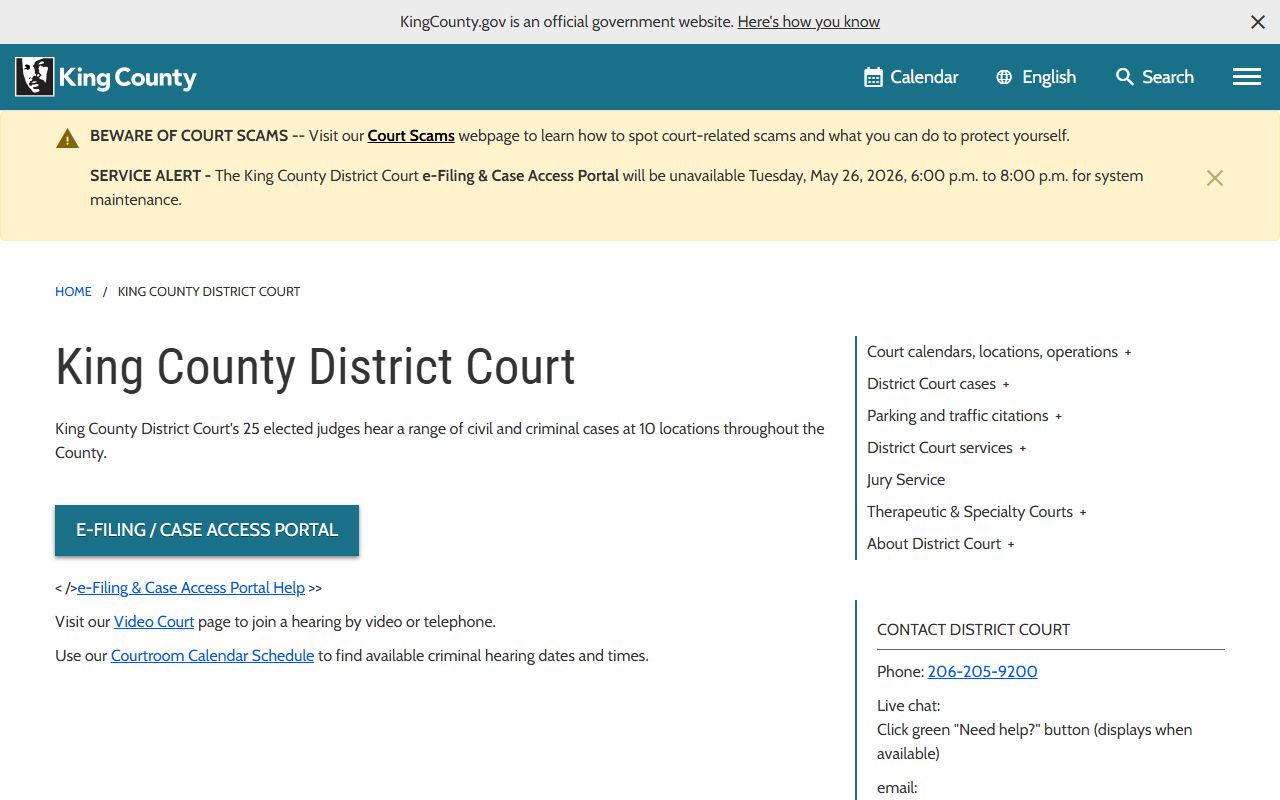
The District Court home page, shown above, posts service alerts, scam warnings, and links into the case-access portal. You can reach it through the King County District Court site.
District Court is spread across 10 locations in East, South, and West divisions. The District Court locations page lists each courthouse with its address and filing area.
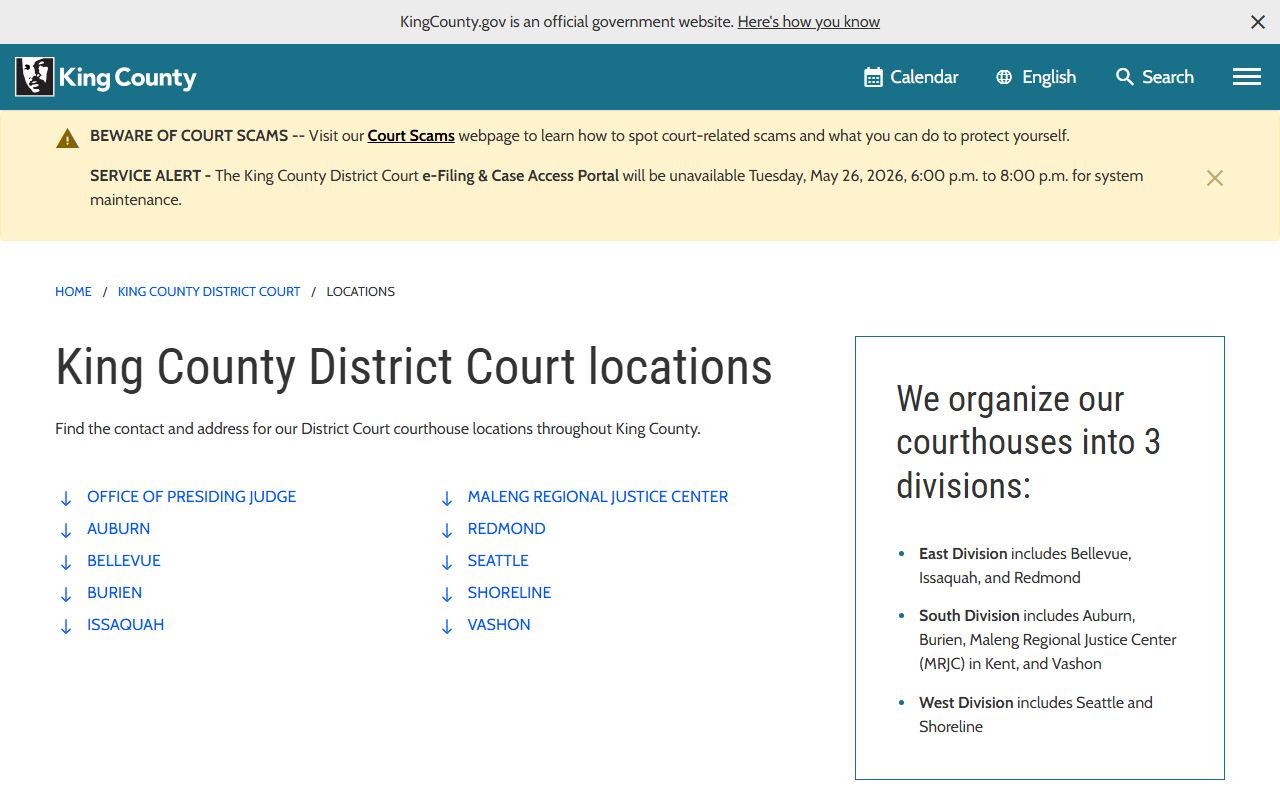
Civil and small-claims filing areas differ by city, so the locations page is worth a look before you file. Full court profiles are on the King County Superior Court page.
Types of Court Records Available in King County
The county produces many kinds of court records, and they sit in different courts. Superior Court holds the heaviest case files. District Court holds the high-volume daily caseload. Knowing the category points you to the right portal and the right clerk.
- Criminal records - felony files in Superior Court, misdemeanor files in District Court.
- Civil records - lawsuits, evictions, judgments, and small claims.
- Family and divorce records - divorce, custody, child support, and parentage in Superior Court.
- Probate and guardianship records - estates, wills, and guardianships in Superior Court.
- Traffic records - infractions and parking handled by District and municipal courts.
Arrest and booking data is separate. Those are jail and sheriff records, not court case files, and you find them through the jail lookup rather than a court portal.
What King County Court Records Show
A court record is built from many small fields. Some are searchable, some appear only inside the file, and some are redacted for privacy. The table below covers the fields you see most often when you open a King County court case.
| Field | What It Shows |
|---|---|
| Case Number | The cause number used to track the case; Superior Court uses XX-X-XXXXX-X |
| Filing Date | The date the case was opened with the court |
| Parties | Plaintiff, defendant, petitioner, respondent, or organization names |
| Charges / Cause | The criminal charge or the civil claim driving the case |
| Disposition | The outcome, such as dismissed, committed, or judgment entered |
| Sentence / Judgment | The penalty, award, or final order the court issued |
District Court adds hearing data, sentence conditions, and warrant status to its portal results. Both systems hide personal identifiers under court rule.
Public Access Laws for King County Court Records
Washington runs two access systems at once. Agency records, such as police reports and county emails, go through the Public Records Act in chapter 42.56 RCW. Court case files go through court rules, mainly GR 31. This split matters. A jail record or prosecutor email follows one path, and a filed pleading follows another. King County routes requests to match, sending court records to the Clerk and agency records through the public-records process.
Key Statutes:
RCW 42.56.030 - the Public Records Act must be read broadly to favor access, with exemptions read narrowly.
GR 31 - the public may access court records except where law, court rule, or court order restricts them.
RCW 42.56.550 - a requester can ask a court to review a denied public-records request and impose penalties.
The full framework, including copy charges under RCW 42.56.120, sits on the King County public records page.
Records That Are Restricted or Confidential
Not every court record is open. Some are sealed by a judge, and some are confidential by statute. Adoption files are confidential under RCW 26.33.330. Juvenile dependency records are restricted under RCW 13.50.100. Mental health and involuntary treatment records are limited under RCW 71.05.620. Sealing and redaction follow court rule GR 15, which requires a judge to make findings before access is cut off.
To view a sealed Superior Court file, an eligible party shows current government photo ID in person, or files a portal request and meets the Clerk over video to verify identity. Some cases are so protected the Clerk will not even confirm that the case exists. Sealed documents cannot be mailed without a court order.
Specialty Courts in King County
King County runs several problem-solving courts inside District Court. The Regional Veterans Court serves veterans whose cases connect to service-related needs such as mental health, substance use, or housing. The Regional Mental Health Court works with defendants whose misdemeanor cases intersect with behavioral health needs. There is also a Domestic Violence Court and a set of Community Courts that link low-level defendants to services and compliance plans. Each uses review hearings, treatment plans, and accountability instead of ordinary case processing.
Superior Court adds specialized operations of its own, including Dependency Court, Family Court Services, Juvenile Court Services, and the Involuntary Treatment Act calendar at Harborview Medical Center.
King County Sheriff and Jail
Adult detention is run by the Department of Adult and Juvenile Detention, not the Sheriff's Office. The county operates two adult jails, the King County Correctional Facility in Seattle and the Maleng Regional Justice Center in Kent. A free Subject Lookup Tool tells you whether an adult is currently in custody, where the person is held, and the booking number. The Sheriff's Office handles sex offender registration and other law-enforcement duties.
You can review sheriff services on the King County Sheriff's Office page. For the jail roster and booking details, see the King County inmate records page, and for active warrants see the warrant records page.
Marriage, Divorce, and Probate Records
Marriage licensing is handled by the King County Recorder's Office, while divorce and probate are Superior Court matters held by the Clerk. A marriage certificate copy comes from the Recorder. A divorce decree comes from the Clerk. See the marriage and divorce records page and the probate records page for the full process, and the Recorder's Office page for recorded documents. A few probate terms come up often.
- Testator
- The person who made a will.
- Executor
- The person named to carry out a will and settle the estate.
- Conservator
- A person appointed to manage another person's property or finances.
King County Court Records Fees
The Superior Court Clerk charges set fees for copies and research. Online viewing of eligible records is cheap, clerk-assisted copies cost a bit more, and certified copies carry a first-page fee plus a per-page charge. Fee waivers are available for people who qualify.
| Item | Amount |
|---|---|
| Online view or download per page | $0.25 |
| Clerk-assisted non-certified copy per page | $0.50 |
| Certified copy | $5 first page, $1 each additional |
| Research fee | $30 per hour |
Audio hearing recordings cost $25 per cause number. A fee waiver, once approved, can last 12 months and cover certified copies. Full details are on the Superior Court Clerk page.
How to Interpret King County Court Records
Court files use shorthand. A docket is the running list of events in a case. A motion is a request for the court to act, and an order is the judge's ruling. A charge is only an accusation, while a conviction is a finding or plea of guilt. A disposition is the outcome of a charge or case. Reading these terms correctly keeps you from misjudging an open case as a closed one. A warrant that has been recalled is no longer active, even though the entry stays in the record. When the meaning is unclear, the Clerk can explain a docket entry but cannot give legal advice.
Accuracy and Record Limitations
Online court data lags behind the paper and the courtroom. KC Script says it may take up to three court days for a filing or hearing to appear. District Court data updates on its own schedule. Names can match the wrong person, and sealed or confidential cases may not show at all. Treat the portal as a guide, not as proof.
Note: Confirm any case detail with the originating court before you rely on it for a legal, financial, or housing decision.
Legal Help in King County
Free and low-cost help is available. The King County Department of Public Defense represents financially eligible people in criminal cases by court appointment. For civil matters, the Northwest Justice Project, Washington LawHelp, and the King County Bar Association offer clinics, referrals, and self-help information.
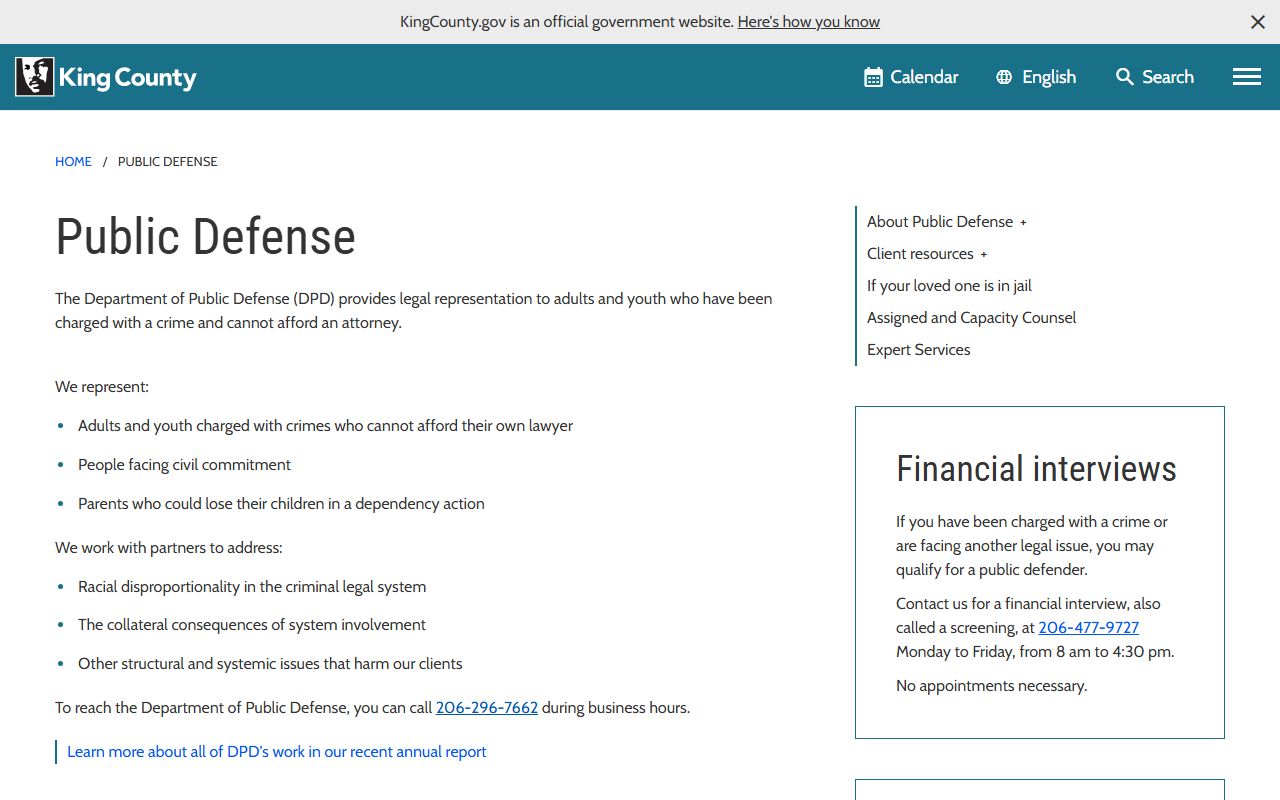
The Department of Public Defense page, shown above, explains appointed defense. Felony prosecution is handled by the King County Prosecuting Attorney, which charges felonies countywide and misdemeanors in unincorporated areas.
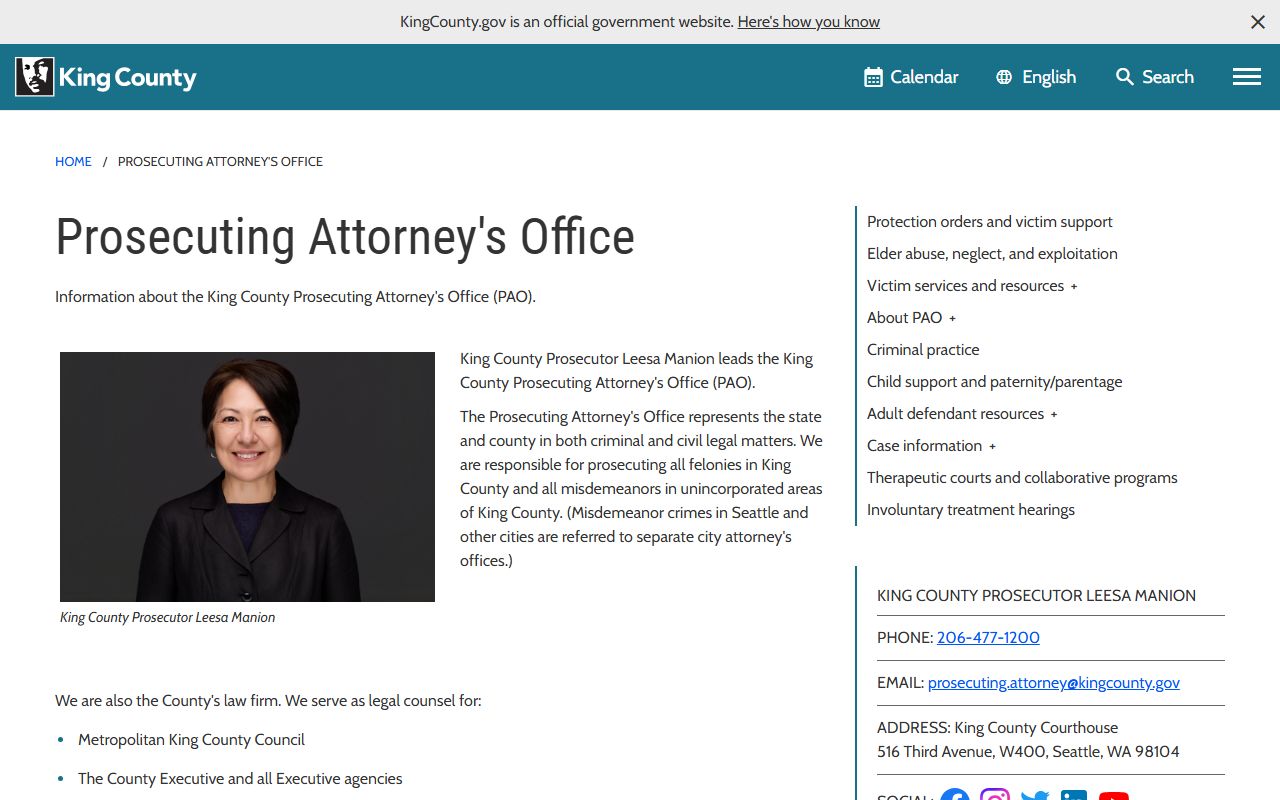
The prosecutor's page also posts a scam warning about callers who claim you missed court and demand payment.
Federal Courts Serving King County
Not every case in the county is a state case. King County falls in the U.S. District Court for the Western District of Washington, which handles federal civil and criminal matters. Federal records run through the national CM/ECF and PACER systems rather than the county portals, so a federal case is searched in a different place from a Superior Court case.
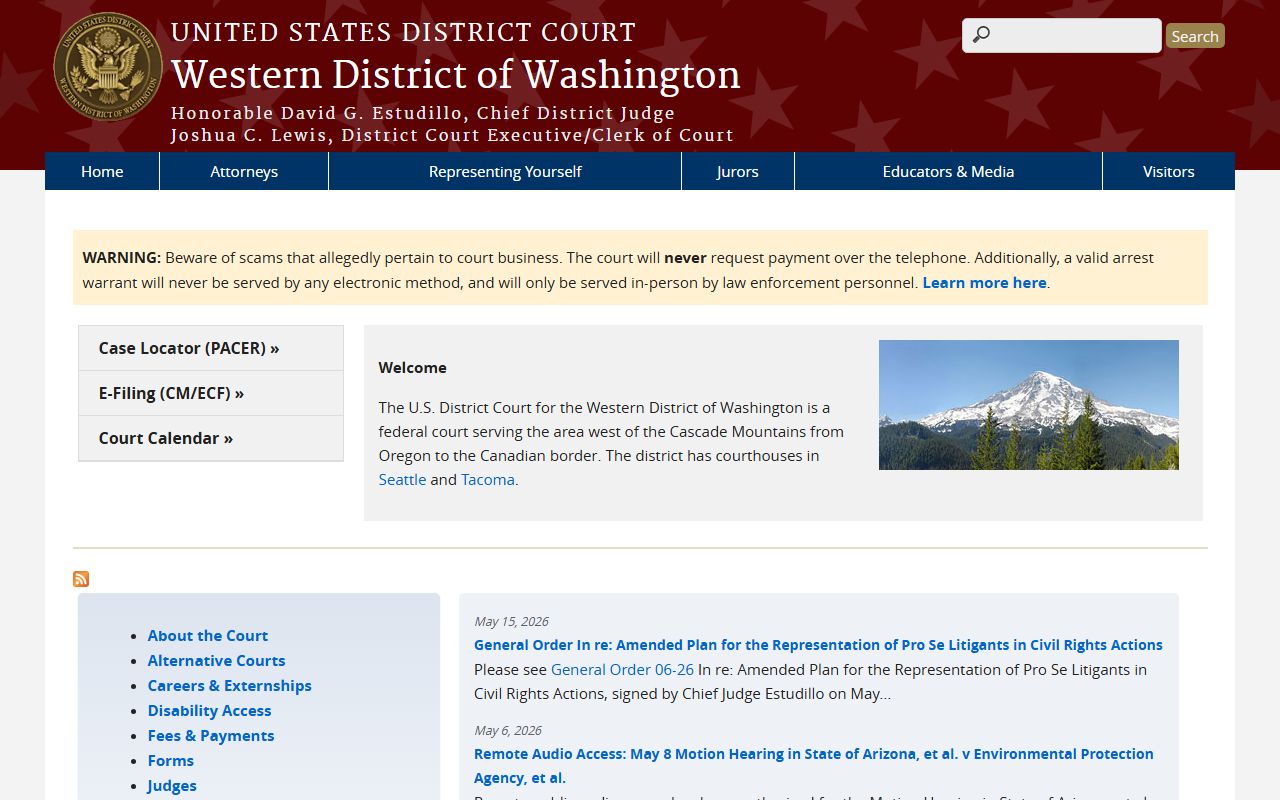
The U.S. District Court for the Western District of Washington is the federal trial court for the region. Electronic filing and docket access run through the court's CM/ECF system.
The Western District CM/ECF portal handles federal e-filing and case access. Bankruptcy is a separate federal court.
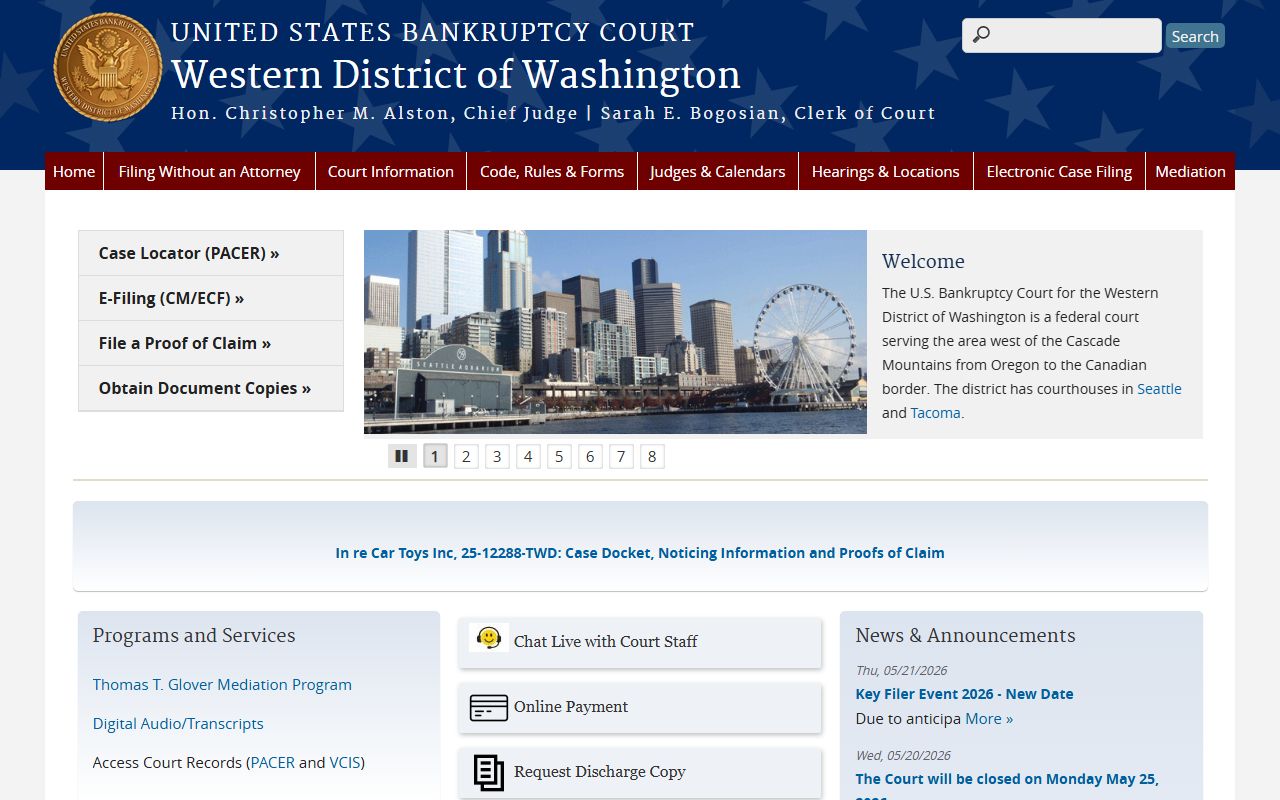
Bankruptcy cases go to the U.S. Bankruptcy Court for the Western District of Washington, and federal appeals go to the Ninth Circuit.
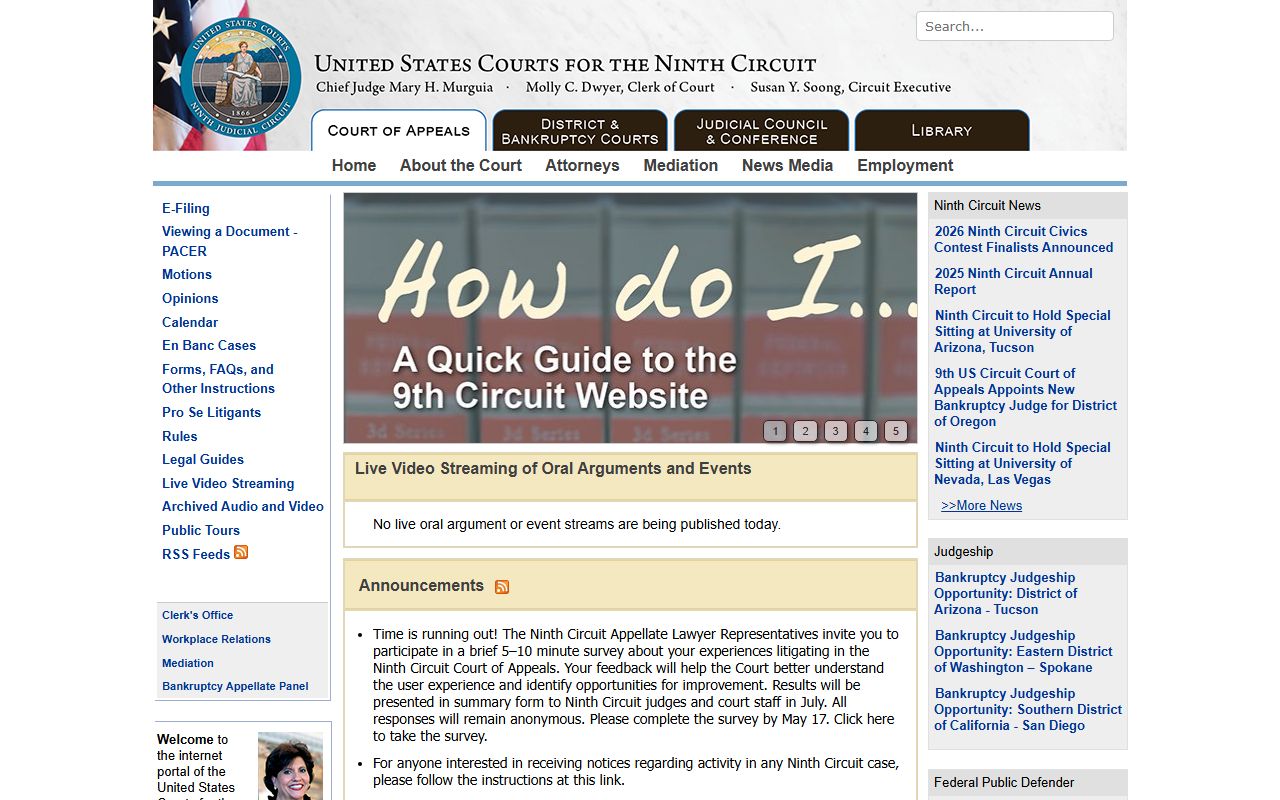
The U.S. Court of Appeals for the Ninth Circuit hears federal appeals, while case documents are reached through the national PACER system.
History of King County Courts
King County was created in 1852, before Washington became a state, and Seattle is the county seat. The King County Courthouse at 516 Third Avenue still anchors the downtown legal district. The King County Correctional Facility opened in 1986, and the Maleng Regional Justice Center in Kent opened in 1997 to expand court and detention access in the south county. Over time the Superior Court grew into the state's largest county trial court, and the District Court became a countywide system with 25 judges at 10 sites.
Frequently Asked Questions
How do I search King County Superior Court records?
Use KC Script, the Clerk's portal. Open the Case Search menu, pick the case type, then search by case number, party name, or filing date. Post-1979 case numbers use the XX-X-XXXXX-X format. The portal data is not the official record, so order certified copies from the Clerk when you need an official document.
Do I need an account to view records?
For online requests and downloads, yes. The Clerk requires a KC Script account to request and view Superior Court records online. You can also visit a courthouse and use a free public access terminal. District Court also requires a free account for case access, though paying a ticket does not.
How do I find someone in the King County jail?
Use the DAJD Subject Lookup Tool. It tells you whether an adult is in custody, the facility, and the booking number. You can also call the adult jail line at 206-296-1234. For a youth under 18, call 206-263-9595.
More answers are on the King County Court Records FAQ page.